
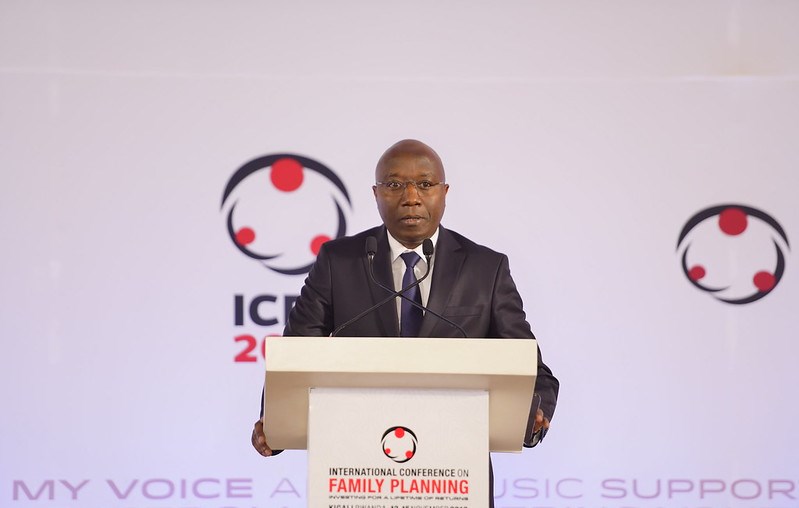
Rwandan Prime Minister, Eduard Ngirente, has called for continued investment in family planning emphasizing that the Family planning has extensive and far-reaching social and economic benefits and called for global commitments to address challenges in contraception access.

Ngirente made the observation at the opening a five day International Family planning Conference(ICFP)at Kigali International Convention Centre in Kigali Rwanda.
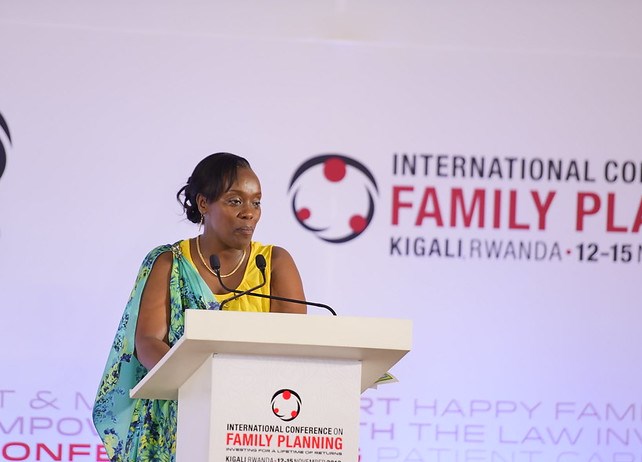
The Rwandan Premier pointed out that Family planning is one of the most cost-effective ways to improve the wellbeing of people in all countries of Africa and pledged his government total support.
’’The African continent is very youthful [and] the biggest challenges facing African leaders today is how to harness our youthful population into agents of sustainable development. Investment in young people and in human capital, in general, can enable us to harness a demographic dividend across our continents.” Ngirente said.
Speaking earlier the Rwanda health Minister, Dr. Diane Gashumba, said that Rwanda is committed to improving awareness and increasing demand for family planning, expanding the range of contraceptive methods available.
“The government of Rwanda had added a long-acting and reversible option, and ensured the availability of family planning to 14,841 Rwanda administrative villages by the 45,000 community health workers in service.” Dr.Gashumba said.
More than 3,700 global policymakers, researchers, young people, faith leaders and family planning advocates from around the world gathered in Kigali, Rwanda to attend the 2018 ICFP themed “Investing for a Lifetime of Returns,” co-hosted by the Bill & Melinda Gates Institute for Population and Reproductive Health at the Johns Hopkins Bloomberg School of Public Health and the Ministry of Health of the Republic of Rwanda.
Speakers highlighted findings from the 2018 findings released at the Conference by Family Planning 2020 (FP2020), a global partnership focused on enabling an additional 120 million women to access voluntary contraception by 2020. According to the report, since 2012, 46 million more women and girls who want to avoid or delay pregnancy have begun using a modern method of contraception in the world’s 69 poorest countries.
This represents an increase that is about 30 percent greater than the historic trend, bringing the total number of women and girls with access to modern contraceptives to 317 million in these regions.
“As of July 2018 the number of women and girls using a modern contraception was the highest in history,” said Dr. Natalia Kanem, Executive Director of the United Nations Population Fund.
“It’s my biggest worry that we still have a long way to go to bring lifesaving modern contraceptives to every woman and girl [who wants to prevent pregnancy] no matter where she is or who she is, so it’s time to pick up the pace. Let us build on the progress we’ve made until we achieve our ultimate goal: universal access.”Dr.Kenem said.
For the first time, the FP2020 Annual Report also includes information on domestic government spending on family planning in 31 countries. While some countries are recorded to spend less than US$50,000 per year on family planning, others have committed more than US$200 million annually.
President of the Global Development Program at the Bill & Melinda Gates Foundation,Dr.Christopher Elias said “If the world is going to keep its promise [to women and girls], it must have to think differently, go beyond linear thinking and be disruptive. “This is essential to bend the curve and get ourselves on track for universal access by 2030.” Dr.Elias said.
Other Speakers at the opening ceremony included Dr. Ellen J. Mackenzie, Dean of the Johns Hopkins Bloomberg School of Public Health; Dr. Natalia Kanem, Executive Director of the United Nations Population Fund; Dr. Christopher Elias, President of the Global Development Program at the Bill & Melinda Gates Foundation;
The Honorable Marie-Claude Bibeau, Minister of International Development of Canada; “It’s my biggest worry that we still have a long way to go to bring lifesaving modern contraceptives to every woman and girl [who wants to prevent pregnancy] no matter where she is or who she is, so it’s time to pick up the pace. Let us build on the progress we’ve made until we achieve our ultimate goal: universal access.”
For the first time, the FP2020 Annual Report also includes information on domestic government spending on family planning in 31 countries. While some countries are recorded to spend less than US$50,000 per year on family planning, others have committed more than US$200 million annually.
Many of the speakers noted Rwanda’s commitment to improving health and access to family planning services, which serves as an inspiration and example for other countries. As of 2014-2015, 48% of all married women in Rwanda are using modern contraception, though more efforts are needed to increase the number of family planning users.
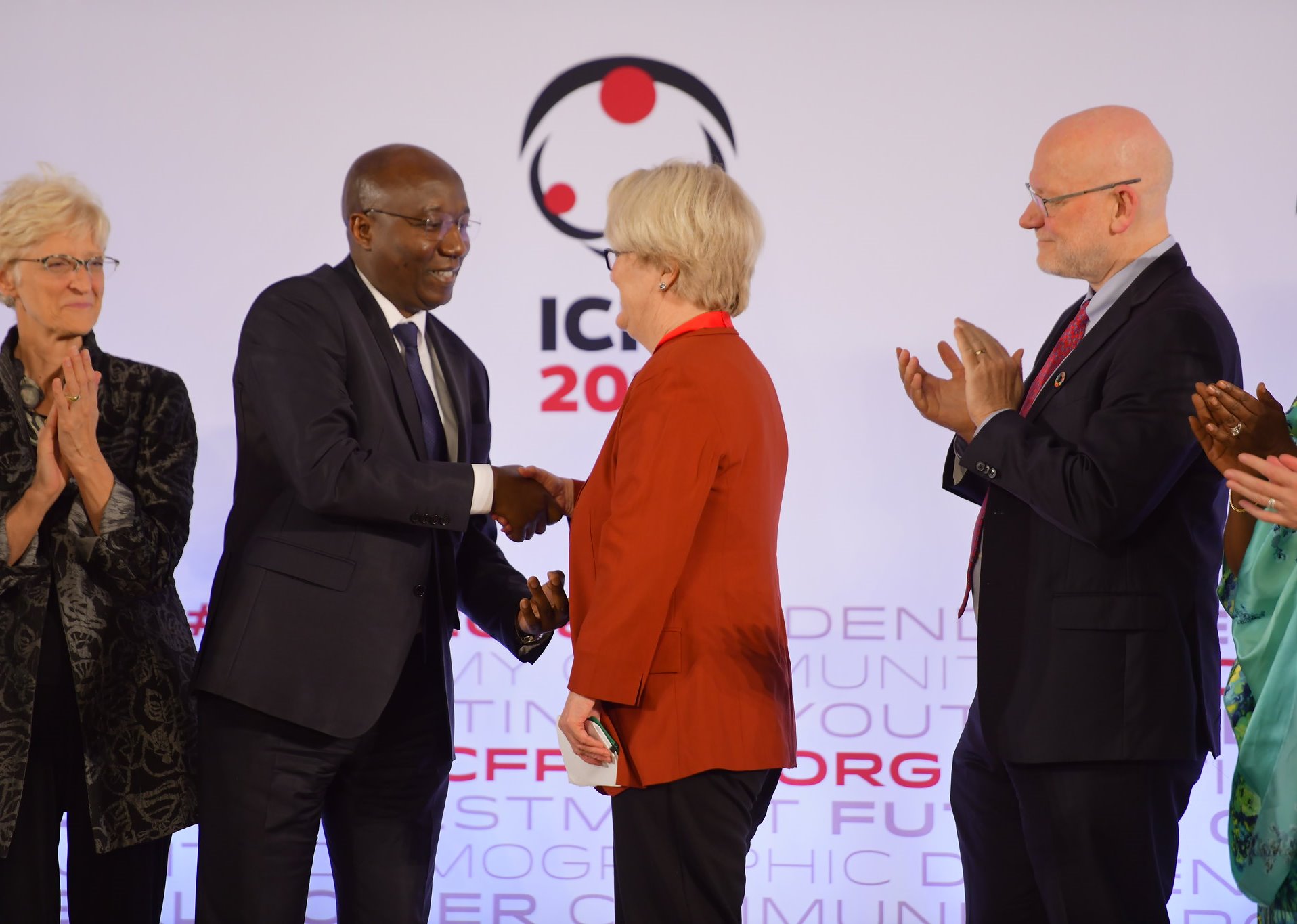
In a related development , Prime Minister Ngirente, presented the Global Humanitarian Award for Women’s and Children’s Health to, Susan Packard Orr, founder and CEO of Telosa Software and member of the Board of Directors of the David and Lucile Packard Foundation.
The award recognizes individuals for their contributions and commitment to advancing maternal and child health and wellbeing, especially family planning, in communities around the world.