
Amanda A. Ngabirano(above in photo) an urban, Planner and Lecturer of Makerere University has praised Kampala city planners, leaders and the NRM government for making bold and unique steps in improving the physical infrastructure of the Kampala city and enhancing its beauty.
Ngabirano a holder of MSc Urban & Regional Planning & Development, University of Greenwich, said the city (city dwellers), which has been busy with road infrastructural expansion and improvement projects first did not appreciate the civil works.
She however told the eastafricanwatch.net that city dwellers and many others now appreciate the importance of a functional urban mobility system in a city.
“The city seems to appreciate capital at that, although it all, still, is clearly disjointed planning. For some projects, from planning to their implementation, it has been rather easy compared to others.
It hasn’t been easy with the pilot Non-Motorized Transport (NMT) project. But it has never been easy in any car-centric city. Kampala took a bold step to plan for and implement its first real project with provision for pedestrians, bicycle riders, green, resting places and motorists in what I would call the heart of Kampala-Kampala’s busiest and crowded zone.” She said.
She added “ In that zone, the road space clearly belonged and still belongs to the pedestrian, amidst hostility from motor vehicles. According to Eng. Kitaka Andrew, Acting Executive Director, Kampala Capital City Authority (KCCA), NMT/active mobility users, had been forgotten in planning and design of road space, and the authority realized that that had to change. The Lord Mayor of Kampala, Erias Lukwago, while launching the project in February last year, said the pedestrian in the city deserved better and attractive walking facilities”.
Amanda said Uganda’s Non-motorized transport policy, which was approved in 2012, clearly emphasizes the need for the provision of safe facilities for active mobility users, particularly, pedestrians, cyclists and people with reduced mobility.
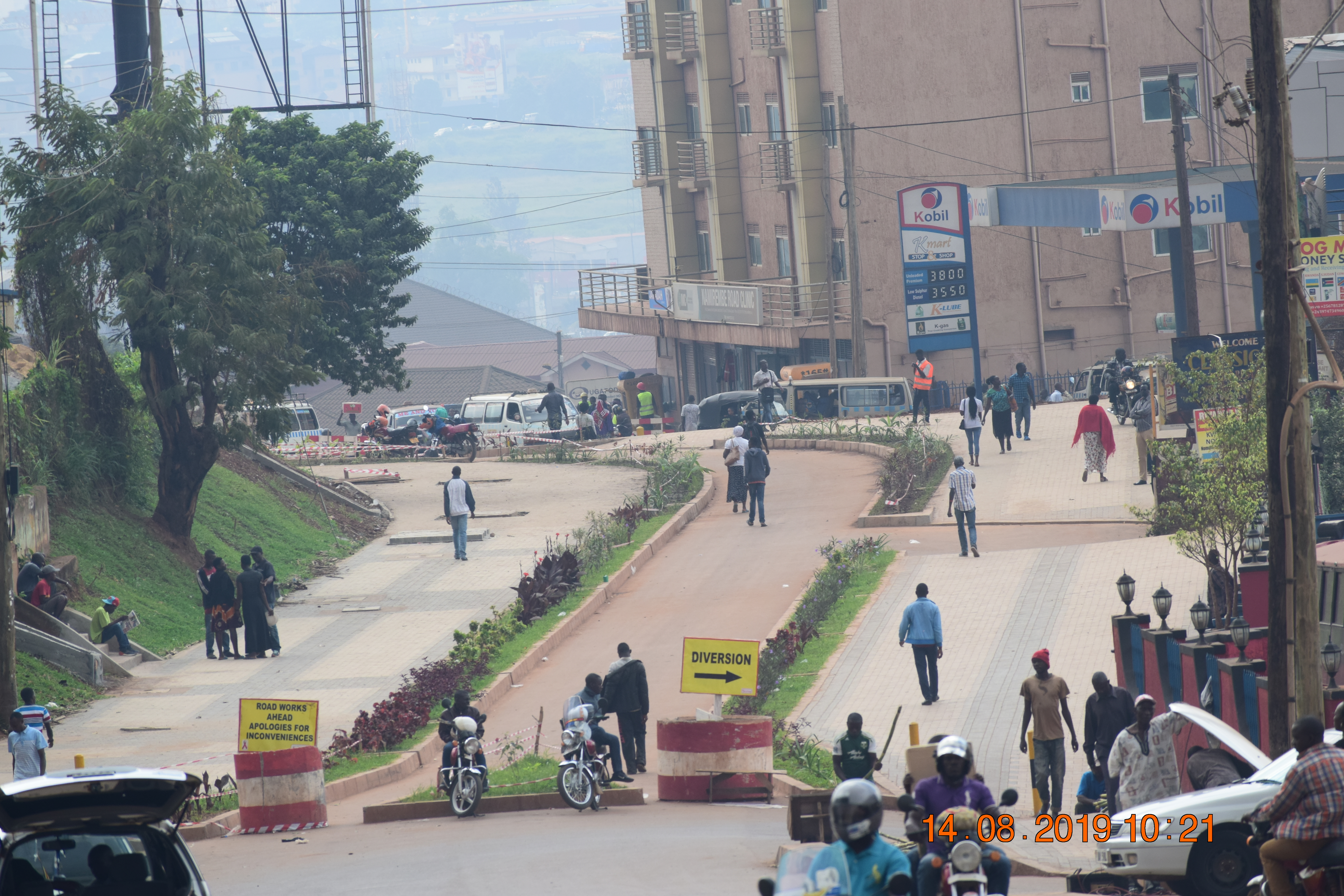
“So anything being done in that regard is ideally, that policy being implemented, although several municipalities are yet to know a thing about it” she added.
The Lecturer said according to a survey conducted in 2010 along Bombo Road, in Kawempe division, 80% of the respondents wished to ride bicycles but hesitated for their safety. 80% of these did not like to ride in mixed traffic, and preferred segregated bicycle lanes.
She also said also, a study conducted by ROM Transportation in 2012, indicated that 60% of Kampala’s daily commuter population walks to work, but without safe and good quality facilities. Even without this survey, it was and is still very obvious even to a first time guest that our walking population is huge, and therefore deserves better. And Kampala went ahead to design and implement its first NMT pilot project, downtown.
Amanda also said that worldwide, the business and public transport hubs usually have a huge pedestrian population. These zones, if unplanned, will have through traffic-motorists who have no business to do with the zone but simply use it to access other areas outside it. This trend, unfortunately, destroys the quality of public space, poses a road safety challenge, affects the air quality and business performance in general. It always results into traffic chaos, which makes such zones unattractive and inefficient, although seemingly busy.
“Kampala’s pilot NMT project has attracted local, regional and international attention. It has been rendered ambitious, impossible, great, smart and undesirable all at the same time; right from its inception. As earlier indicated, this has been the case worldwide when it comes to planning to reclaim public space. Such plans are normally received with fear of the unknown from the general public and selfishness from motorists, particularly in a car-centric city like ours,” she added.
Amanda also said the new Namirembe road-Luwum Street stretch speaks volumes about Kampala’s respect for all road users but also the unity of the technocrats, politicians, business owners and public transport operators.
She added that even taxi leaderships in the city have welcomed the developments going on in Kampala and is partly mainly due to the view that the planning was inclusive .
“The thing about this particular change and development though is that the pedestrian numbers have not just been introduced in downtown Kampala. The change is that the city authority and government of Uganda has realized that that huge population is human too, ought to be provided for and prioritized. This investment is clearly a perfect example of inclusiveness and relevant planning-investing where the demand already exists” Amanda added.

She said with increasing travel costs, obesity (due to lack of physical activity), traffic congestion, air pollution and deterioration of the quality of public space, any smart city ought to learn a thing from Kampala.
“Although we still have our challenges, (just like most cities do), for instance, inadequate public transport and poor road user behavior, our city got this one right” Amanda added.
She said as Uganda celebrates this bold and smart step, the leaders must pay special attention to the raised concerns such as loading and off-loading vehicles blocking the walkways, boda bodas using both walkways and cycling lanes, the design needs for people with disabilities, lighting as well as planting trees to enhance aesthetics.
Amanda added, “these call for several action steps and enforcement is one of them. There has also been a valid reaction regarding riding from ‘nowhere to nowhere”, which literally means KCCA should extend the network to other parts of the city, for the design to be more meaningful. Nevertheless, great job, Kampala. African cities should learn to take such bold people-centered decisions for inclusiveness and efficiency”.
She said people have shared on her social platforms and lauded the developments taking place in Kampala city.