

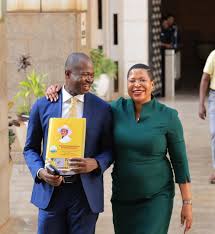

In the span of just a few days, the political fortunes of former Speaker of Parliament Anita Among collapsed with remarkable speed, while the profile of Jacob Oboth Oboth surged to the center of Uganda’s power dynamics. At the heart of that dramatic shift stood one man: David Kabanda.
The Kasambya County MP, who serves as secretary general of the Patriotic League of Uganda (PLU), has increasingly emerged as one of the most influential political mobilizers within the ruling establishment. Over the past week, Kabanda became the key conduit through which political signals from the camp of Muhoozi Kainerugaba were transmitted to Members of Parliament, ultimately altering the trajectory of the highly contested Speaker race.
Political observers say the rapid sequence of events demonstrated how swiftly alliances can shift within the ruling coalition and how a single authoritative message can trigger a nationwide political realignment almost overnight.
Ironically, Kabanda had initially played a central role in strengthening Among’s position.
In March, he authored a letter rallying legislators aligned to the PLU to support Among for Speaker and Thomas Tayebwa for Deputy Speaker. At the time, the move was interpreted as evidence that Among enjoyed consolidated backing from Muhoozi’s camp and remained the undisputed candidate within the ruling establishment.
That endorsement significantly reinforced perceptions that Among faced no meaningful internal resistance. MPs close to the PLU quickly fell in line, and the signal from Kabanda appeared to cement her dominance ahead of the race.
But in a dramatic twist, the very figure who helped solidify Among’s political strength would later become instrumental in dismantling it.
Within the past week, Kabanda formally communicated the withdrawal of the earlier endorsement, announcing that support for Among had been “retracted and withdrawn with immediate effect.” The abrupt reversal stunned many MPs and instantly transformed the political atmosphere surrounding the Speaker contest.
Because the message came directly from Kabanda — a close political ally and trusted communicator of Muhoozi’s political line — its impact was immediate and far-reaching. The statement was widely interpreted as confirmation that elite support for Among had collapsed at a critical moment.
The timing of the communication proved decisive.
PLU legislators were subsequently instructed to align themselves with candidates endorsed by President Yoweri Museveni, a move that effectively dismantled Among’s support base within sections of the ruling coalition.
For many MPs, the withdrawal of backing was not viewed as a routine political adjustment but as a direct signal that the center of power had shifted elsewhere. Lawmakers who had publicly or privately aligned with Among suddenly found themselves politically exposed, while undecided MPs quickly began recalculating their loyalties.
Almost simultaneously, the political vacuum created by Among’s decline opened the door for Oboth Oboth’s rapid emergence.
Shortly after support for Among was withdrawn, Muhoozi publicly endorsed Oboth Oboth, praising his performance in government and positioning him as the preferred candidate for Speaker. The sequence of events — withdrawal first, endorsement second — underscored Kabanda’s role as the bridge between Among’s political fall and Oboth Oboth’s rise.
Inside the ruling National Resistance Movement (NRM), the effects were immediate.
MPs who had previously considered Among politically untouchable were forced to reconsider their positions within hours, while fence-sitters interpreted the developments as a clear instruction on where the establishment now stood. Analysts say the episode highlighted the growing influence of the PLU structure in shaping parliamentary calculations.
Kabanda’s involvement did not stop at public statements.
At a thanksgiving event hosted by Oboth Oboth at his home in Mukono, Kabanda reportedly took charge of mobilization efforts personally. Even MPs who remained undecided were reportedly subjected to direct political persuasion during the gathering.
Witnesses say Kabanda conducted what amounted to a political roll call, ordering MPs to stand as he communicated the official PLU position and conveyed Museveni’s endorsement of Oboth Oboth.
The dramatic scenes further reinforced perceptions that the political operation had become highly coordinated and centrally directed.
The mission has since been branded “Operation Maliza Ufisadi” by Muhoozi — a phrase loosely translated as an operation to “end corruption” — and has quickly evolved into one of the most controversial political campaigns in recent weeks.
However, Kabanda now says his prominent role in the operation has come at a personal cost.
The legislator claims he has begun receiving death threats and intimidation linked to his involvement in the political maneuvering that reshaped the Speaker race.
In a strongly worded statement, Kabanda revealed that he is considering stepping away from frontline politics altogether once the operation concludes.
“After this Operation, I will retire from active politics to pave the way for others to serve. Public offices demand safety, respect and accountability,” wrote Kabanda.
“I can no longer serve under death threats and blackmail. I did not tell anyone to steal government resources.”
His remarks immediately triggered reactions from Muhoozi, who publicly rejected the idea of Kabanda retiring from politics.
“Who is threatening you? Send me their names,” Muhoozi responded.
“Also, you are forbidden from retiring!”
The escalating tensions have added another layer of intrigue to an already volatile political contest that has exposed deep divisions, shifting loyalties and intense power struggles within the ruling establishment.
Kabanda’s growing visibility has also attracted criticism from some political figures allied to Among.
Recently, Justine Nameere publicly confronted Kabanda, declaring that she did not fear him despite his expanding political influence. Others have gone even further, accusing him of behaving like Judas Iscariot for allegedly betraying Among after previously mobilizing support in her favor.
With alliances continuing to shift and political tempers rising, the fallout from the operation is likely to shape internal NRM politics far beyond the Speaker race itself.


