
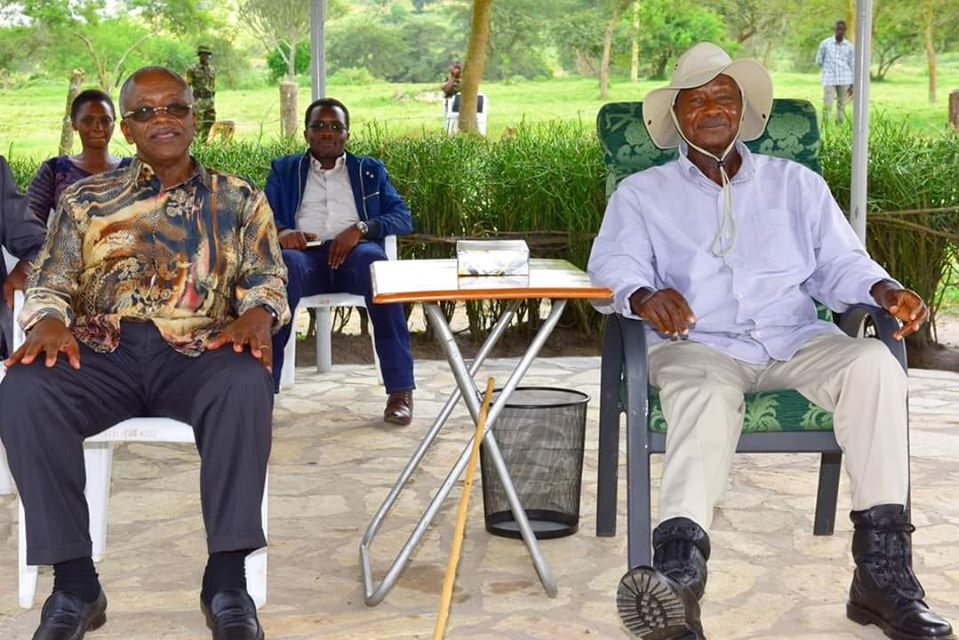
President Museveni on Tuesday evening this week met former Prime Minister Amama Mbabazi at his ranch in Kisozi, Gomba District.

A picture shared on social media showed the President seated next to Mbabazi, his long-term colleague whom he replaced as prime minister ahead of the 2016 elections. Mbabazi later contested against Museveni for president and lost.
This meeting and earlier engagements seem to suggest that Mbabazi is about to make a return to the ruling party and the government. If he does will he replace Ruhakana Rugunda who displaced him on 18th September 2014? To replace or displace in this case means causing Rugunda’s exit from his position.
Mbabazi as a double card
Amama Mbabazi in his tenure was very instrumental as a Prime Minister who fundamentally led and managed government business as the post of Prime minister suggests. He not only worked so well as PM but was a solid secretary General of the National Resistance Movement (NRM) Party whom we are told the party and government has been missing. He was at one time referred as supper Minister when he held more than one ministerial portfolios.
Mbabazi is also a regional card and if he replaced or displaced Rugunda he would as well cover Kigezi region and would manager the NRM’s opposition and the party bickering.
“Although tough JPM was a very effective MP who is missed in Government and a better Kigezi regional representative. Hon and Ndugu Rugunda who replaced him is a good man but has been silent” an MP stated.
“Mbabazi who is younger than both President Museveni and Rugunda could fit best in the succession equation anchoring ground for a younger leader in the future” the MP added.
The MP who preferred anonymity said was not surprised with the latest developments between President Museveni and Mbabazi saying in politics there are no permanent enemies.

WHO IS JPM?
John Patrick Amama Mbabazi, (JPM) was born 16 January 1949, is a Ugandan politician who served as the ninth Prime Minister of Uganda from 24 May 2011 to 19 September 2014. He played an instrumental role in Uganda’s protracted liberation struggle from several tyrannical governments (1972-1986) and is a founding member of the National Resistance Movement, the ruling political party in Uganda.
Mbabazi served as the Member of Parliament for the Kinkiizi West constituency in Kanungu District, a position held from 1996 until 2016, when he ran unsuccessfully for the Presidency.
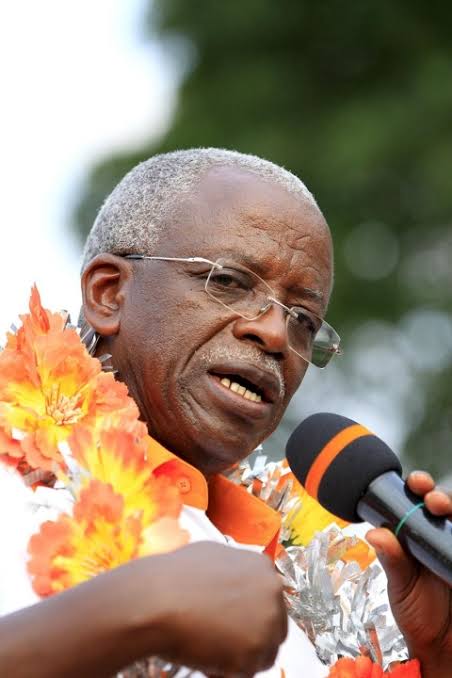
He was born in Mparo Village, Rukiga County, in present-day Kabale District, on 16 January 1949. He attended two of the most prominent educational institutions in Uganda during both the colonial and post-colonial periods: Kigezi College Butobere for his high school education, and Ntare School for his A-Levels. Mbabazi earned a Bachelor of Laws from Makerere University.
He received a postgraduate Diploma in Legal Practice from the Law Development Center in Kampala.[1] He is an Advocate of the Courts of Judicature of Uganda and has been a member of the Uganda Law Society since 1977.
Before joining politics, he worked as a state attorney in the Attorney General‘s Chambers from 1976 to 1978, rising to the position of secretary of the Uganda Law Council from 1977 to 1979
Between 1986 and 1992, he served as head of the External Security Organization.
He has also served as Minister of State in the President’s Office, in charge of political affairs. He became secretary of the NRM caucus in the Constituent Assembly that drafted the 1995 Uganda Constitution.
Between 1986 and 1992, he was Minister of State for Defence. Subsequently, he served as Minister of State for Regional Cooperation from 1998 to 2001. He was Attorney General and Minister of Justice from 2004 to 2006, a feat that earned him the moniker “Super Minister”.
He was appointed as Minister of Defence in 2006, a position he held until he was appointed as Minister of Security. He served as Minister of Security from February 2009 until May 2011, when he was appointed Prime Minister.
He was Secretary General of the NRM from November 2005 to January 2015.
Presidential bid
Mbabazi’s childhood friend Ruhakana Rugunda was appointed to replace Mbabazi as Prime Minister on 18 September 2014, by President Yoweri Museveni. This move was seen by many as Museveni’s way of punishing Mbabazi for his rumoured presidential run. On 15 June 2015, Mbabazi declared his intentions to run against Yoweri Museveni for the National Resistance Movement‘s nomination for president at the party’s convention on 4 October 2015This declaration was followed by a response from President Museveni who dubbed it “bad conduct and premature”.
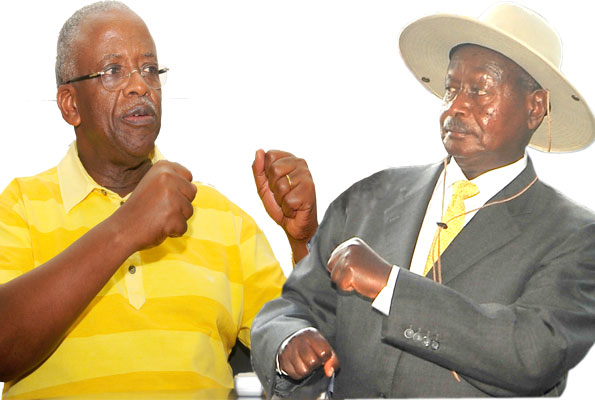
On 31 July, after much disagreement between top-ranking party officials and Mbabazi himself, the former Prime Minister declared he would stand as an independent candidate. His candidature is backed by The Democratic Alliance (TDA), a loose convergence of minor political parties working to win the position of presidency.
In the 2016 general election he received 1.39% of the vote, placing third.
Diplomacy
Mbabazi has represented Uganda in international fora, including the United Nations Security Council, where he argued for the international community to allow the Uganda People’s Defense Force to pursue the Lord’s Resistance Army fighters into the Democratic Republic of the Congo.
Mbabazi is married to Jacqueline Susan Ruhindi Mbabazi.
WHO IS RUGUNDA
Ruhakana Rugunda (born 7 November 1947) is a Ugandan politician who has been Prime Minister of Uganda since 2014. A physician by profession, he held a long series of Cabinet posts under President Yoweri Museveni beginning in 1986. He served as Uganda’s Minister of Foreign Affairs from 1994 to 1996 and as Minister of Internal Affairs from 2003 to 2009. Subsequently, he was Permanent Representative to the United Nations from 2009 to 2011 and Minister of Health from 2013 to 2014.
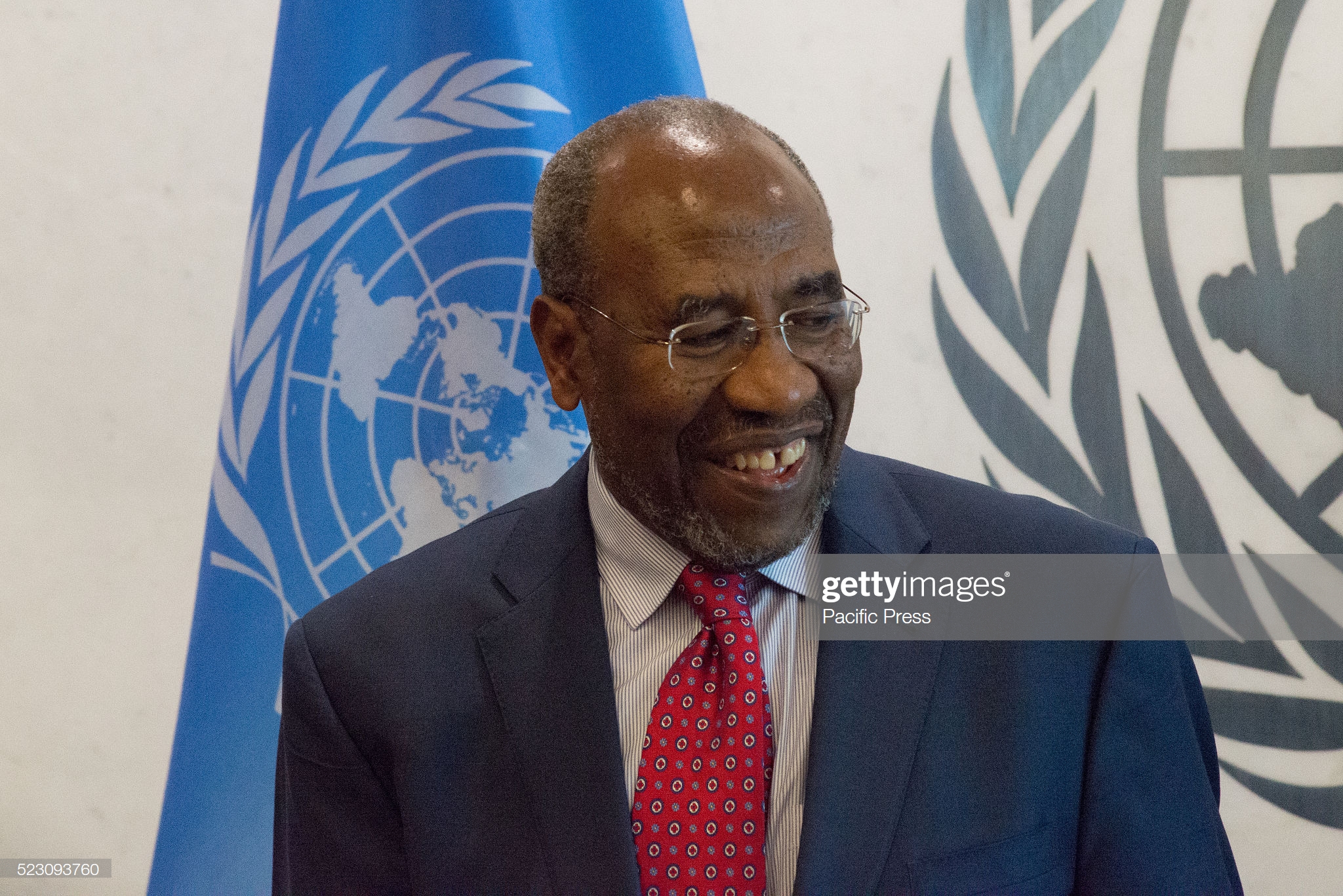
He was appointed as Prime Minister on 18 September 2014. He replaced Amama Mbabazi, who was dropped from the Cabinet.
Rugunda was born in Kabale District on 7 November 1947. As a young boy, he would often sit and read the newspapers to his father Surumani Rugunda, and it is these experiences at an early age that sparked his later interest in politics. Rugunda attended Kigezi High School and Busoga College Mwiri where he served as head prefect, before joining the Makerere University Medical School and later the University of Zambia where he studied medicine, graduating a Bachelor of Medicine and Bachelor of Surgery. He later studied at the University of California, Berkeley and obtained a Master of Science in public health.[2] Before joining Ugandan politics, Rugunda worked as medical officer in Zambia, as a physician at the District of Columbia General Hospital in Washington, D. C., and at Kenyatta National Hospital in Nairobi, Kenya
Political career
While attending Makerere University in Uganda, Rugunda, commonly referred to as “Ndugu” (Swahili for “brother”) by friends, served as President of the National Union of Students of Uganda (NUSU), a political youth movement. As a young political activist, Rugunda was part of the Uganda People’s Congress (UPC) and was said to be close to President Apollo Milton Obote.
After Museveni took power in 1986, Ruganda held a long series of Cabinet posts: he was Minister of Health from 1986 to 1988, Minister of Works, Transport and Communication from 1988 to 1994, Minister of Foreign Affairs from 1994 to 1996, Minister of Information from 1996 to 1998, Minister at the Presidency from 1998 to 2001, Minister of Water, Lands and Environment from 2001 to 2003, and Minister of Internal Affairs from 2003 to 2009.[4]
He also served as Chairman of the NRM Electoral Commission, as Member of Parliament for Kabale Municipality, and as President of the Governing Council of the United Nations Environment Program (UNEP).[5] In July 2006, Rugunda led a Ugandan government negotiating team to Juba, Sudan to hold peace talks with the Lord’s Resistance Army.
In January 2009, he was appointed as Uganda’s Permanent Representative to the United Nations. At the same time, the position was elevated to Cabinet Ministerial level in Uganda.[6] He twice served as the President of the Security Council in July 2009 and in October 2010 during Uganda’s two-year stint on the Security Council. In the cabinet reshuffle of 27 May 2011, he was instead appointed as Minister of Information and Communication Technology. In May 2013, he was moved to the post of Minister of Health, replacing Christine Ondoa, who became an advisor to the President of Uganda on public health matters.
Rugunda is married to Jocelyn Rugunda and together they are the parents of four sons. He enjoys reading, playing tennis and chess in his spare time.