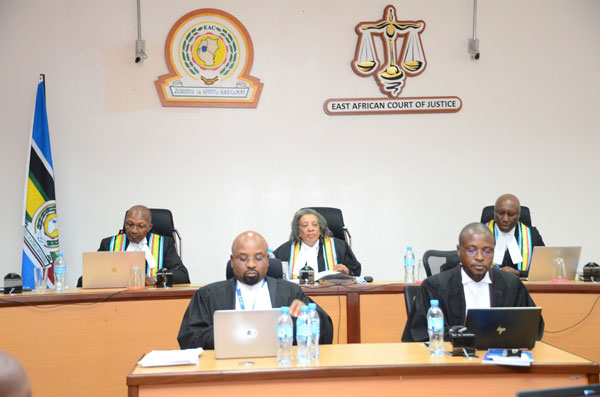
The East African Court of Justice (EACJ) has dismissed a petition by a number of civil society organisations challenging the construction of the East African Crude Oil Pipeline.

In its ruling, the EACJ said the petition was filed late (2020) when the memorandum of understanding for the project construction had taken place. The court said the petitioners should have filed the documents in 2017, at the initiation of the project.
“Consequently, when the Applicants filed their Reference on 6tn November 2020, this was well over two months after execution of the IGA,” the ruled on Wednesday, 29 November 2023.
The Africa Institute for Energy Governance (AFIEGO), Natural Justice, Centre for Strategic Litigation, the Centre for Food and Adequate Living Rights (CEFROHT) Limited, in November 2020 filed a case against the governments of Uganda and Tanzania, and the Secretary General of the East African Community (EAC), challenging the construction of the EACOP at the EACJ.
The applicants wanted a temporary injunction to stop the construction of the EACOP until the questions of environmental, social justice, and climate justice concerns raised in the case were heard and determined.
But the court sitting in Arusha upheld the objection by Tanzania’s solicitor general, noting that the case was filed out of time.
The applicants wanted a temporary injunction to stop the construction of the EACOP until the questions of environmental, social justice, and climate justice concerns raised in the case were heard and determined.
The Court sitting in Arusha on Wednesday ruled on the preliminary objections raised by Tanzania’s solicitor general. The court upheld the objection by Tanzania’s solicitor general, noting that the case was filed out of time prescribed by the East African Community Treaty.
The ruling was delivered by Justice Yohane B Masara (principal judge) Justice Dr. Lawrence Gacuke, Justice Dr. Charles Nyawello, Justice Richard Muhumuza and Justice Richard Wabwire Wejuli.
The judges held that the applicants should have filed the case as early as 2017, rather than in 2020 and as a result, the court does not have jurisdiction to hear the matter.
The governments of Uganda and Tanzania signed the Host Governments Agreements for the East African Crude Oil Pipeline (EACOP) in 2017. The lawyers representing the government of Uganda argued that the matter should have been filed at that time.
The Attorney General of Uganda was represented by Martin Mwambutsya, the Director Civil Litigation, Goerge Kalemera (Commissioner For Civil Litigation) , Richard Adrole Assistant Commissioner for Civil Litigation , Charity Nabaasa and Mugisha Twinomugisha.
The ruling means that the applicants cannot proceed with the merits of the case. AFIEGO issued a statement saying the ruling will negatively impact the environmental rights of Ugandans, Kenyans and Tanzanians.

It said the applicants will appeal the ruling. It said they (applicants) believe that the judgment failed to take into consideration pertinent facts that would have allowed the applicants to have the merits heard before the Court.
“Despite the setback we have suffered, we remain determined and are prepared to appeal this unjust ruling, firmly believing that the dangers posed by EACOP can and will be stopped,” said Kamugisha
Lucien Limacher, Head of Defending Rights and Litigation of Natural Justice said the Court of First Instance for the East African Court of Justice failed to provide civil society with the chance to argue their case.
“This judgment marks a continuation of how the global north and various government institutions in Africa are blind to the destruction of the environment and the impact oil and gas has on the climate. Profit is valued above livelihoods and the environment. We will evaluate the judgment in detail and make the necessary actions to ensure we continue to protect the environment and the people who live in it.”
Deus Valentine Rweyemamu, the Chief Executive Officer of CSL said they respect the court’s decision but feel that an opportunity to hold the governments of Tanzania and Uganda accountable for non-compliance with the EAC treaty provisions on the environment and other environmental laws has been missed. “We shall engage our legal team and proceed with an appeal,” he said.
Dale Onyango of Natural Justice said while they are disappointed by the court’s decision, they respect the legal process and will carefully review the ruling.
“Our commitment to environmental sustainability, social justice, and climate resilience remains unwavering. We will explore all available avenues to continue advocating for the well-being of our communities and the protection of our environment.”