By Oweyegha-Afunaduula
15th May 2024
I knew he had an operation at Mulago Hospital in the 1990s. In fact, when Henry Mayega (today
called Ambassador Henry Mayega) and I went to see him after the operation, he told us,
“Never hold urine in your urinary bladder for long. As soon as you feel you want to urinate, go to
the toilet immediately”. It is dangerous to hold urine for a long time. It was the cause of my problem.
I have been holding urine for a long time. It affected my prostate gland. Lucky enough it has been
removed before it became cancerous”.
Those words kept on sounding in my ears until today. In fact, two days ago in sleep I heard the
professor speaking the same words in my ears while in sleep. It was not surprising. I have since
October 2023 been on treatment to stabilise my prostate gland. Quite expensive.
I wouldn’t managethe financial demands if a long-time friend in Canada, Counsel and politician Davies Bagambiire, didnot intervene. However, I believe it was the caution that Professor Patrick Rubaihayo sounded toHenry Mayega and myself that has helped most to prevent my prostate getting infected by microbesfrom my urinary bladder.
So when my former postgraduate student, Muhumuza Harriet, sent me a WhatsApp message today
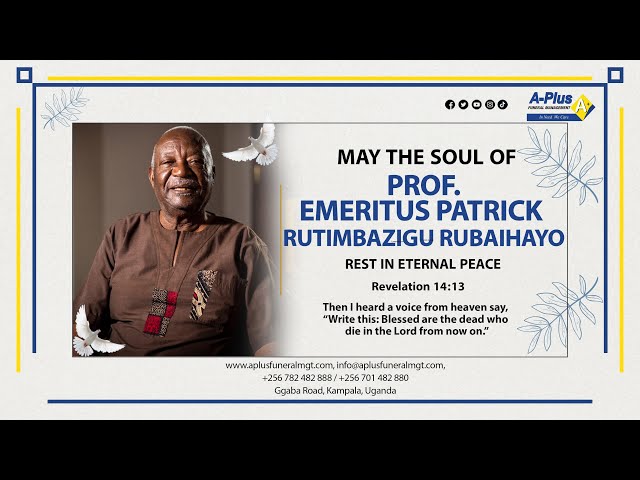
informing me that Professor Emeritus Patrick Rubaihayo was no more, I was greatly devastated.
I had heard of Professor Patrick Rubaihayo in the early 1980s when I was a postgraduate student in
the Zoology Department at Chiromo Campus of Nairobi University as one of the very few Ministers
of Apollo Milton Obote between 1980 and 1985. However, I did not meet him until 1991, when I
joined Makerere University’s Department of Zoology as a lecturer. Apart from Dr. Pantaleo Kasoma
who was the Head of that Department at that time, Professor Rubaihayo was one the very first
people I met and knew in Makerere in the first one week, thanks to Henry Mayega, then an
administrator in the Vice Chancellor’s office.
Mayega became an instant acquaintance because of similar political orientation towards the Uganda
Peoples Congress (UPC). Apart from introducing me to Professor Patrick Rubaihayo, he introduced
me to many academics and administrators who were staunchly UPC, including Professor Adoniya
Tiberondwa, Prof. Akiiki Mujaju, Prof. Kagendo Atwoki, Prof. Opolot, Mr. Patrick Kirunda, and many
others.. I settled in quickly and became influential very early although I had never been educated at
Makerere University, but at the University of Dar-es-Salaam and University of Nairobi.
My association with Professor Patrick Rubaihayo grew from weak to strong to excellent. I would
always check on him at his office in the Faculty of Agriculture and forestry and he would check on
me at the Faculty of Science. He taught me a lot about Uganda politics, since I had been out of the
country for about two decades. He also convinced me to accept that the best politicians are
scientists. At that time, he did not know like I did that science is one with three dimensions – natural,
social and arts (or humanities).
Professor Patrick was a member of the Presidential Policy Commission (PPC) of the Ugandan
People’s Congress (UPC), which was functioning as a Presidium since the Party President was in exile
in Zambia. He asked me to visit Uganda House, the building that housed the headquarters of the
party on Floor Six. He asked Henry Mayega to accompany me. When Mayega and I went, we found
all the members of the PPC waiting for us. At the time, the recently fallen Iron Lady, Cecilia Ogwal,
was the Chairperson of the PPC and Dr James Rwanyarare was her deputy. The PPC was a diverse
group with great representation of all parts of Uganda. However, it was finding it difficult to operate
under the increasingly militarised and politically exclusive governance of the country by the new
group from the bush, the National Resistance Movement/Army. However, the members were very
courageous. I found Professor Patrick Rubaihayo a very courageous politician. One day, when
Mayega and I visited the UPC headquarters, we found the PPC members discussing what they all
thought was true: that the political leadership of Uganda was overinfested with Rwandese Tutsis. I
heard them agreeing, under their chairperson, Cissy Ogwal, that Uganda was occupied and needed
freedom from Rwandese Tutsis. The most vocal on this issue was Professor Patrick Rubaihayo. The
PPC tasked him and the then National Chairman of the party, Haji Badru Wegulo, to draft a policy
statement on the issue of domination of the political space and other spaces by the Rwandese Tutsi
The real drafter of the party position on Rwandese Tutsi was Professor Patrick Rubaihayo. It seems
he was chosen to draft the party position guided by history. I learnt that back in Ankole he had tried
to send Rwandese Tutsis from the swamps back to their country of origin – Rwanda, because they
were interfering with the politics of the country. In fact, when the party position document was
finally printed and produced, it was so scathing that it angered the Head of State, Yoweri Museveni,
as he was then called. The president chose to address the nation over the matter in full combat
fatigue. He ordered the arrest of Professor Patrick Rubaihayo and Haji Badru Wegulo and their
incarceration in Luzira Maximum Prison. The President showed that the issue of who is citizen of
Uganda was squarely in his hands when he simultaneously granted citizenship to one of his
Ministers, then Brigadier Moses Ali, and widely known to be a Nubian from South Sudan.
Eventually Patrick Rubaihayo and Haji Badru Rubaihayo were released from Luzira by order of the
President. Rubaihayo remained true to his party but Haji Badru Wegulo was routinely accused of
working for the regime from within the UPC. Much later in the early millennium, when the military
invaded UPC Headquarters and shot at the lift in Uganda House before arresting the man who
replaced Cissy Ogwal as Chairman of PPC, Dr James Rwanyarare, and shooting down a journalism
student called Higenyi, Haji Wegulo was accused of hiding himself away when the Party
headquarters were being raided by men with guns.
Patrick Rubaihayo remained strong in articulating the ideals of his party and criticising the excesses,
suppression and oppression and other vices reigned on the people by the rulers. While party leaders
such as Cissy Ogwal, Haji Wegulo, Henry Mayega deserted the UPC, either for NRM or Forum for
Democratic Change (FDC) Professor Patrick Rubaihayo remained in his party and preferred to fight
from withing to ensure good leadership in the party. Earlier in the 1990s, he played a critical role in
the formation of the Interpolitical Forces Committee (IPFC), which fielded Dr Paul Kawanga
Ssemogerere against President Yoweri Museveni.
If we still had men of Character rather than characters, then Professor Patric Rubaihayo stood astute
as a man of character till his death.
We shall remember his contributions to agricultural development during a most difficult period
when the government of which he was a part was also allocating time, energy and money to
combating the rebels now in government for more than 38 years at the exclusion of pluralism and a
pluralistic society in Uganda. His time as Minister of Agriculture was the last time Agriculture was
taken to be far more important than the military, State House, President’s Office and politics.
May His Soul Rest in Peace!
–