

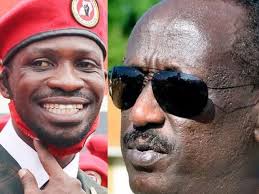
A new political exchange has emerged between Gen. Salim Saleh and opposition leader Bobi Wine, after the retired general advised the musician-turned-politician to first grasp President Museveni’s economic philosophy, widely known as “Musevenomics.”

Gen. Saleh, President Museveni’s brother and senior presidential adviser, issued the remarks in a statement on Sunday, seemingly responding to Bobi Wine’s recent criticism of the First Family and calls for Museveni’s peaceful retirement.
In his statement, Gen. Saleh, whose civilian name is Caleb Akandwanaho, spoke in a firm but fatherly tone, telling Bobi Wine that he had yet to fully understand the president or his long-term vision for Uganda.
Saleh’s full statment bellow;
“Dear son, that friend of mine does not understand Museveni,” Saleh wrote. “President Museveni took me back to school,” he added, explaining how the president once helped him understand national planning and development.
The retired general’s comments came just days after Bobi Wine’s campaign rally in Nakaseke District, where the opposition leader addressed the First Family directly. During his speech, Bobi Wine described Saleh as “the only reasonable one” in the family and urged him to advise the president to step down peacefully to avoid angering the public.

The exchange quickly caught public attention, with many Ugandans debating whether Gen. Saleh’s response was an attempt to lecture the opposition leader or a genuine call for understanding. Some political observers believe Saleh’s remarks were meant to soften the tone of political rivalry by steering the conversation toward economic ideas rather than personal attacks.
To provide context, the idea of Musevenomics dates back to 1986, when President Museveni took power. It is described as a homegrown economic philosophy focused on transforming Uganda’s economy from subsistence farming to modern production. The philosophy emphasizes grassroots wealth creation and self-reliance as the foundation of national development.
Musevenomics is said to rest on nine key pillars, including awakening peasants to join the money economy, adding value to local products, ensuring security for people and property, promoting zero tolerance for corruption, and encouraging economic and political integration. Supporters of the idea credit it for Uganda’s economic growth and stability over the past four decades.
By reminding Bobi Wine about Musevenomics, Gen. Saleh seemed to suggest that the opposition should focus on studying Uganda’s economic framework before criticizing the president’s leadership. He implied that a deeper understanding of Museveni’s philosophy might lead to more constructive political dialogue.
As the political back-and-forth continues, it remains to be seen whether Bobi Wine will respond to Gen. Saleh’s message. For now, the exchange has sparked a new wave of debate about Uganda’s economic vision, leadership legacy, and the relationship between the First Family and the opposition.


