

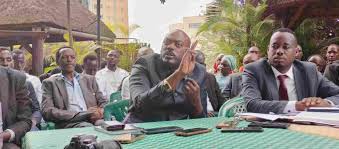

The Ugandan-Banyarwanda Cultural Development Association, known by their acronym as Umubano, have denied meeting the Executive Director of the National Identification and Registration Authority (NIRA) as portrayed by several social media reports.
It is alleged on social media news that Umubano met with NIRA to iron out their differences on registering and renewing national identity cards for the Banyarwanda.
“We wish to categorically state that the Ugandan Banyarwanda community and its leaders have not been invited to any such meeting nor have we received any official communication regarding the event. The circulating message is inaccurate and misleading, and does not reflect the true situation or the community’s position,” said Hon Simon Kayitana, the Chairman of Umubano in a press statement released on July 11, 2025 in Kampala, Uganda.
This development follows a meeting between President Yoweri Museveni and the group that calls itself the Bavandimwe on June 23, 2025, at State House, Entebbe, in the presence of Ministers and Officials from the Ministry of Internal Affairs, Immigration and the NIRA.
Apparently, the Bavandimwe led by social commentator Frank Gashumba is the group recognized by President Museveni as true Banyarwanda yet Umubano is the legitimate group that represents Banyarwanda in Uganda. President Museveni and State Agencies claim that Umubano represents Rwandan, which allegation hasn’t been proved as a fact.
In 2021, a group of Banyarwanda led by Gashumba rebranded themselves as “Abavandimwe,” a term aimed at distancing themselves from perceptions of being Rwandan nationals. This move, they argued, was necessitated by widespread discrimination stemming from their association with Rwanda.
Often, this group has accused officials of the Ministry of internal affairs of subjecting them to humiliating treatment under tough interrogation when they mention they are Banyarwanda by tribe.

They also accuse the Directorate of Citizenship and Immigration Control officials of treating them as foreigners from Rwanda unless they prove themselves otherwise. Among the many documents they are asked to provide to prove their belonging to Uganda include land titles, letters from local leaders, and ancestral records dating back to 1926.
However, some credible sources in government claim that the Gashumba group is sponsored by the State to cause confusion amongst the Banyarwanda community.
President Yoweri Museveni on January 23, 2025 issued an executive order instructing the Ministry of Internal Affairs to stop denying Ugandan passports to rightful citizens. The directive limits recognition of Ugandan-Banyarwanda citizenship to individuals from Kisoro, Ntungamo, Mpororo, (South Western Uganda) and those born of intermarriages, leaving out significant clusters within the community.
President Museveni directed that upon receipt of an application for a passport, officials of the Directorate of the Citizenship and Immigration Control should address themselves to the provisions of section 40 of the Citizenship and Immigration Control Act, Capt. 313 which only requires a person to produce his or her National Identification Number (NIN) and to comply with any other requirements prescribed by the board.
“All administrative processes through which a person might be required to prove citizenship, especially by birth, must uphold the dignity of all persons and no requirement not provided for or contemplated under the law should be applied,” he said.
Museveni’s directive has been rejected by Umubano, labelling it discriminatory and unconstitutional. Instead, Umubano has been mobilizing Banyarwanda to push for the amendment of Article 10 of the 1995 Constitution.
The point of contention between President Museveni and Umubano is that the former wants Banyarwanda who seek identity cards and travel documents to first apply for naturalization (as other foreigners) whereas the latter wants Banyarwanda from all over Uganda to be recognized as an indigenous community as provided for in the Independence Constitution (1962).
In the State House meeting of June 23rd President Museveni advised that Immigration Authorities and NIRA should cease to determine citizenship for applicants and instead leave that role to community leaders and local authorities.
The local authorities, in this case, are the chairperson local council 1, the chairperson local council III, the Gombolola Internal Security Officer and the Resident District Commissioner.
The implication of Museveni’s decision is that the groups he has created and led by Frank Gashumba will now have authority to assess an individual’s citizenship. Yet Gashumba has rejected the identity of Banyarwanda and calls his people Bavandimwe. It also means that Bavandimwe is recognized by the President as a legal ethnic group yet the Constitution provides for Banyarwanda not Bavandimwe. It is unheard of that the identity of an ethnic group can just be changed by a president. Even a law wouldn’t have mandate to change the identity of an ethnic group.
In addition, in the same State House meeting, President Museveni rejected dual citizenship for Ugandans that may also claim citizenship for African countries. He said: “What we cannot accept now is dual citizenship for neighbouring, or indeed, all African countries, for now. Dual citizenship for now should be for our children who went to European, Arab and Asian countries, mainly because of the insecurity here and there descendants.”
President Museveni’s assertion, therefore, implies he is indirectly altering the 1995 Constitution without actually following the due process of amendment of the Supreme law.
Without Parliament changing the law on citizenship, President Museveni’s directive is bound to cause more confusion for citizens and his government. Yet the president says the law is not the problem nor has gaps in it.
However, the President has directed that the Directorate of Citizenship and Immigration Control should not confiscate nor cancel national identity cards issued by NIRA without following due process prescribed by law.
The Ministry of Internal Affairs spokesperson Simon Peter Mundeyi defends the scrutiny of Banyarwanda applicants, citing concerns that some Rwandan nationals exploit their shared ethnic identity to obtain Ugandan documents. This, Mundeyi argued, necessitated stringent vetting to distinguish genuine Ugandan citizens from impersonators.
But, in the new executive, Museveni’s order asserts that investigating citizenship by birth is beyond the mandate of the Immigration department.
“It is not the mandate of the Directorate of Citizenship and Immigration Control to investigate citizenship by birth and should there be a question about the veracity of the information provided by an applicant for a passport, who has indicated that they are a citizen by birth, DCIC should refer the matter to NIRA by the process prescribed under the Registration of Persons Act,” reads part of the executive order.
However, Fred Mukasa Mbidde, the Umubano legal advisor, who doubles as the Deputy President of the Democratic Party and former member of the East African Legislative Assembly says that the executive order presents Kinyarwanda speakers as non-citizens.
“The order presents Kinyarwanda speakers except those from Mpororo, Kisoro, and Ntungamo as non-Ugandans who should apply for naturalization as non-citizens. It risks making over 6 million persons born in Uganda, stateless, and violates international and subregional human rights instruments,” Mbidde wrote on his X page. He added that they will be challenging their treatment in the East African Court of Justice. “We call for a fresh and urgent dialogue with the President for a fair solution,” he added.
The issue of Banyarwanda citizenship has been contentious throughout Uganda’s post-colonial history. However, it gained more steam when in 1986, Banyarwanda refugees living in Uganda helped the National Resistance Movement/Army gain power.
In the 1995 constitution, the Banyarwanda are listed as among the indigenous tribes of Uganda. However, even with this enshrinement, questions about their citizenship have lingered on.


