
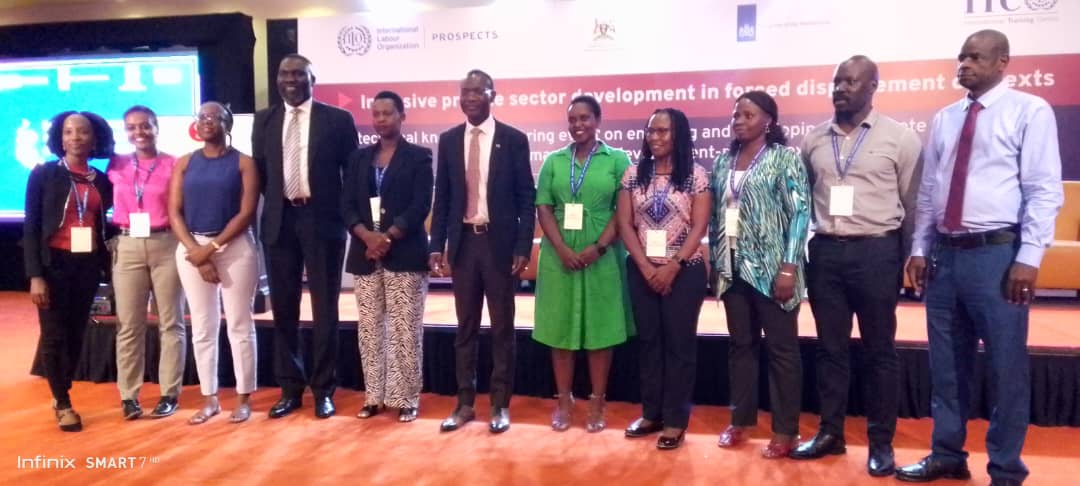
The International Labor Organisation (ILO) and partners have engaged in a three days meeting from 17th to 19th Oct on the status of refugees and shared experiences ranging from access to employment and work permits, Identifications for refugees and the travel documents at Speke Resort hotel Munyonyo in kampala.

The focus, under the topic of Inclusive Private Sector Development in Forced Displacement Context, was to ensure a favorable environment that seeks to recognize the wellbeing and livelihood for refugees in their communities and countries.
Some among the refugees that attended the engagement, asked different governments especially in Africa to recognize their small business startups in the host communities and encourage natives as well to support them because they are also entitled to paying taxes that develop the economies.
According to Coffi Agossou, Deputy Regional Director ILO, “I thank the Ministry of Gender, Labour and Social Development as a co-host, and our social partners like UNHCR, UNICEF, IFC and the World Bank for their active participation and to the Kingdom of the Netherlands for their support and commitment.”
Over the three days, multiple perspectives from some of the most crisis impacted regions in the world have been heard and come to appreciate the complexity of markets in fragile contexts. The context where operations are often heavily affected by multiple and overlapping financial, political, climate and social crises that would otherwise appear to dissuade private sector investment and business growth, he said
However, coming away from this event, there is proof that through collaboration, mutual understanding and a shared commitment to inclusive growth and development, these contexts do offer opportunities.
Coffi added that although the situations are diverse and it is critical to understand these while identifying pathways, one element of note is the enthusiasm participants in this event have put forward in sharing experiences, inquiring about different opportunities, acknowledging common challenges and starting to generate solutions.
“We gained insight from refugee and host community entrepreneurs themselves who despite considerable barriers, have sustained and grown businesses that are responsive to the needs of local communities, whether that be a need for financial service delivery in remote areas or preventative treatments against malaria.”
Another key point is to start small, build over time and maintain an agile mode apparatus, therefore it has been seen how financial institutions trialled small loan products in refugee communities in Iraq, Ethiopia and Sudan, and after observing near perfect repayment rates, felt confident in making longer-term and larger investments, he included.
“Across participants from the private sector, governments, UN agencies, financial institutions, cooperatives, social partners and business development service providers there is a need for strengthened collaboration. We are not all experts in everything, but together we have resources, technical capacity and contextual knowledge to support growth and development,” he said.
The Government of Uganda has a generous refugee policy and seeks to encourage refugees to settle as opposed to staying within camps, so that policy has seen the money being given to refugees to reduce over time, the Executive Director Federation of Small and Medium Sized enterprises Uganda, noted.
Therefore refugees need to be encouraged to start and run successful businesses and we have been very active in supporting refugees to run their businesses, to rescaling through financial literacy and digital skills, he described.
However, refugees need to be supported to run businesses because that really can contribute to the local economy as they can buy, produce and add value. They can make money and pay taxes, can employee Ugandans, therefore the workshop was meant to share experiences from the different countries in which the ILO is integrated, Walugembe added.
Additional reporting by Benjamin Mwibo