

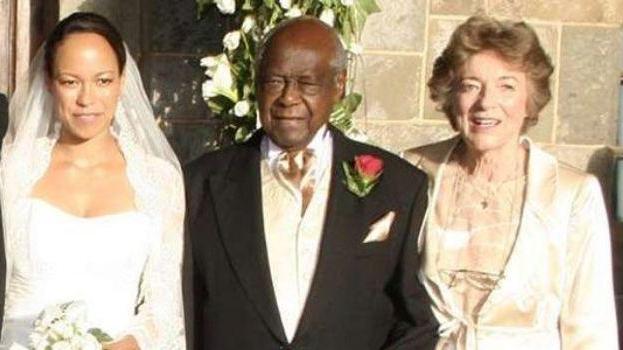
Kenya’s first native Attorney-General Charles Njonjo who died on last week in Nairobi after complication with of pneumonia related illness had his wish carried out when a Kenyan Air force Helicopter scattered his cremated remains on the ice covered slop of Mount Kenya as per his wish.
The ex-AG’s son-in-law, Carey Ngini, who is the husband of Njonjo’s second born daughter Mary Wambui Njonjo, confirmed in an exclusive interview with the eastafricanwatch.net reporter, that the remains now lay safely with his ancestors on the top of the Kean Highest MOUNTAIN.
According to Ngini, the 101-year-old had been ailing for almost a year, starting 2020.
“Over the course of last year (2020) and this year (2021), he’d been battling one ailment or another, very well despite his age,” said Ngini, who added that the cremation was conducted at the Kariokor Hindu Crematorium on Sunday.
On why Njonjo was cremated almost immediately after his death, Ngini said: “He had a long career as a civil servant, and he was also a lawyer by training. So, he was a man who was very clear about instructions, and a man who was very clear about what he wanted, not just in life, but what he wanted in death as well.
“Part of his instructions were that we perform a cremation immediately or immediately after his passing. He didn’t want any fanfare, he didn’t want a lot of ceremony, he didn’t want a lot of what goes with funerals and passing of people of his stature. He was very clear that we must cremate him immediately after he passes on.
“As a family, we chose to fulfill his wishes, and we have now cremated him. We cremated him at around 10:30am today. He is now at rest. The cremation [process] was quite quick.”

On why he thinks Njonjo’s life spanned a century, which is quite rare in a country where people’s lifespan averages 66.7 years, Ngini said: “I wish I knew [his secret to long life]. If I knew that secret, I would bottle it, sell and it and I would be quite wealthy. He was a very disciplined individual. Some of it also must be [due to] genetics; his parents also lived to a ripe, old age. But I think, at the end of the day he ate well, he exercised and he lived a disciplined life.” Ngini eulogized Njonjo as a “special family man”.
“He was a very special family man; his son, his two daughters and wife came first. He was a very charitable person at heart, he helped many people. He was the best father and grandfather that any family would wish to have. He will be missed,” he said.
Charles Mugane Njonjo served as Kenya’s first native Attorney-General between 1963 and 1979. He retired as AG aged 60. He took over from Eric Griffith-Jones, the British Attorney-General of the British administration in Kenya, who was appointed to the position on May1, 1955.

Shortly after retirement as AG, Njonjo was elected unchallenged to the National Assembly in April 1980 as the Member of Parliament for Kikuyu Constituency.
Late President Daniel Moi appointed him to Cabinet in June 1980 to serve as the Minister for Home and Constitutional Affairs.
Njonjo is survived by a widow, Margaret Bryson, and three children, Wairimu Njonjo, Wambui Njonjo and Josiah Njonjo.
In a related development a a world-renowned Kenyan conservationist and fossil hunter,Dr.Ricard Leakey has died aged 77.
Dr. Leakey‘s groundbreaking work contributed to the recognition of Africa as the birthplace of humankind. He also spearheaded campaigns to stop poaching in Kenya, famously burning the country’s stockpile of poached ivory.
Kenyan President Uhuru Kenyatta said after announcing his that, Leakey had “served the Kenyan nation with distinction”.
Leakey served in various positions in the Kenyan government including the National Museums of Kenya, the Kenya Wildlife Service and as head of the civil service.
“Besides his distinguished career in public service, Dr Leakey is celebrated for his prominent role in Kenya’s civil society where he founded and successfully ran a number of institutions,” Mr Kenyatta said.
Leakey followed in his parents’ footsteps in pale anthropology – the practice of seeking to understand human evolution by studying fossils and ancient tools.
In his 20s, Leakey made his own important finds, and in two ground-breaking books (Origins and People of the Lake), he explained the emergence of Homo erectus, an ancestor of modern humans.
His work contributed to the growing body of evidence that the earliest humans had lived on the African continent.
In 1981, he fronted a seven-part television series called “The Making of Mankind”, which made him a household name.
In the late 1980s, he switched careers to take over as head of Kenya’s Wildlife Service at a time when poachers were wiping out the country’s entire elephant and rhino populations. He told his rangers to shoot poachers on sight and organized the spectacular public burning of a huge haul of ivory.
In 1993, the small plane he was flying in lost power and crashed. He survived but both of his legs were amputated below the knee.
That did not stop him from entering Kenyan politics, setting up a new political party, Safina. But his political career did not last and in 1998 he took up a role as head of Kenya’s civil service, with a mission to fight official corruption.
He lasted three years in the role before returning to the Kenya Wildlife Service. At the time of his death, he was serving as chairman of the Turkana Basin Institute at Stony Brook University in the US.
In his will Dr.Leakey asked his family to bury him on the escapement of the Eastern Lift Valley, the place he enjoyed most when still alive.


