

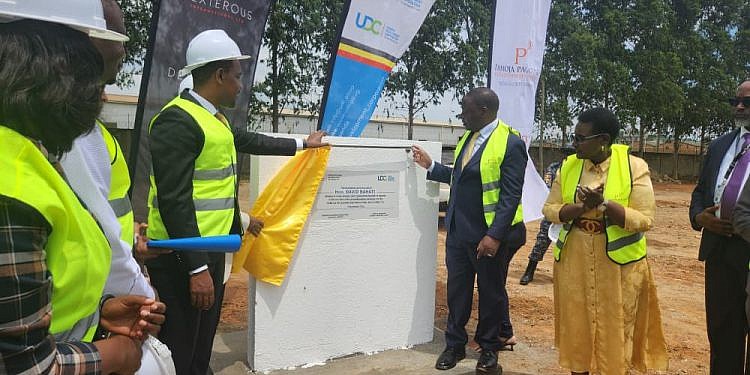

Ugandan manufacturers could soon benefit from increased access to locally produced packaging materials following the groundbreaking of a new manufacturing plant at Namanve Industrial Park, with investors projecting monthly production of 100 million packaging units and the creation of more than 1,000 jobs.
The facility will serve businesses in the food and beverage, agro-processing, pharmaceutical, healthcare and retail sectors, many of which currently depend heavily on imported packaging materials.
Speaking at the groundbreaking ceremony, Pamoja Packaging Board Chairman Moses Abindabizemu said the investment was intended to address the challenges local entrepreneurs face in accessing affordable and readily available packaging materials, particularly those involved in agricultural processing.
He identified banana processors, dairy farmers, tea producers, grain traders and coffee exporters among the businesses expected to benefit from the project.
He explained that dairy farmers in western Uganda struggle to access multi-layer carton boxes and food-grade plastic containers, while tea producers in the Rwenzori region sometimes have to import packaging materials from China, waiting for months before they can package their products.
He said similar challenges affect grain producers in eastern Uganda and sesame and sorghum processors in northern Uganda.
According to Abindabizemu, dependence on imported packaging materials significantly increases production costs for local businesses, with packaging accounting for between 30 and 60 per cent of the production costs of some finished products.
“Did you know that for every finished product you see that you hold, be it a juice, be it a soda, be it anything you have in your hands, 30-60 per cent of the cost of production of that product is from packaging materials? So just imagine the cost is imported. That is why we are here,” he said.
Abindabizemu revealed that approximately 90 per cent of the machinery required for plastic packaging, paper packaging and printing had already arrived at the project site.
The company expects to complete construction within 12 months, after which the facility is projected to produce close to 100 million packaging units monthly.
He added that the factory is expected to employ more than 1,000 Ugandans, with priority given to residents of the surrounding communities.
“We believe more than a thousand Ugandans will be working here. And I can confirm to you that the majority of those will be from this village,” Abindabizemu said.
State Minister for Trade, Industry and Cooperatives David Bahati, who officiated at the groundbreaking ceremony, said Uganda spends approximately $500 million (about Shs2 trillion) annually importing packaging materials, describing the expenditure as an export of jobs and wealth to other economies.
“When you import goods worth $500 million, it means you are exporting jobs, you are exporting wealth. And this is the importance of Pamoja Industries,” Bahati said.
He said local production of packaging materials would help Ugandan manufacturers improve the presentation of their products and compete more effectively in regional and international markets.
“Every material that we make here means a dollar saved from importation of these materials. It means export promotion because one of the challenges we have been having is that our goods are questioned about their quality but also about the presentation,” he added.
Bahati said the government was committed to supporting the investment, adding that UDC could consider additional financing as the factory expands.
UDC board member Edward Nyatia said the project would address a critical gap in Uganda’s manufacturing value chain, revealing that the country imported approximately $6.3 million worth of corrugated cartons and another $2.3 million in folding cartons in 2024.
He said the imports drain foreign exchange while supporting employment in countries where the packaging materials are manufactured, denying Ugandans opportunities to produce the same goods locally.
“That money leaves our economy and goes outside. The jobs it supports are created elsewhere, and our manufacturers wait longer and pay more, especially at customs, for packaging that could be produced right here at home,” Nyatia said.
He added that UDC’s participation was intended to support strategic industries, promote local entrepreneurship, create employment and advance import substitution in line with the government’s Fourth National Development Plan (NDP IV).
Former Trade Minister Amelia Kyambadde welcomed the investment, describing it as an important milestone in the growth of indigenous manufacturing businesses.
She said the packaging industry had historically been dominated by foreign companies, making the emergence of locally owned enterprises an important step towards advancing the Buy Uganda Build Uganda (BUBU) agenda.
However, Kyambadde challenged UDC to consider investing in cold storage infrastructure to address post-harvest losses and strengthen the connection between agriculture and manufacturing.
“The narrative of industrialisation is empty if you don’t have storage,” she said, citing the loss of perishable produce, including mangoes and tomatoes, due to inadequate storage facilities.
She argued that investment in cold storage would complement manufacturing by helping farmers preserve their produce, reduce wastage and supply processors with more reliable quantities of agricultural raw materials.
Meanwhile, Kange Immaculate Angela, the LC1 chairperson of Degeya-Senyi, welcomed the investment, saying it would stimulate economic activity and create employment opportunities for residents.
She urged the investors to prioritise people from surrounding villages during recruitment to ensure that the local community directly benefits from the project.
The groundbreaking ceremony was held as part of UDC’s 10-year anniversary celebrations.
Bahati said the corporation would mark the milestone on November 20, celebrating investments aimed at expanding Uganda’s industrial capacity, creating employment and building local wealth.
The Namanve project is expected to strengthen domestic packaging supply chains, reduce reliance on imported industrial inputs and improve the competitiveness of Ugandan products in regional and international markets.


