


Ardagh Group’s core purpose is to “make packaging for good,” reflecting its commitment to the circular economy through the use of permanent, infinitely recyclable materials, particularly metal and glass, which can be recycled repeatedly without loss of quality. The Group’s core values – Inclusion, Trust, Teamwork, and Excellence – underscore its stated commitment to responsible business practices, ethical conduct, and sustainable development.
Ardagh Group also emphasizes social responsibility throughout its supply chain, expecting its suppliers and business partners to uphold social and ethical rights and conduct business responsibly. Its Code of Conduct and Responsible Procurement Policy establish expectations for suppliers, with requirements based on the principles of the Ethical Trading Initiative (ETI) Base Code. Furthermore, the Group states that it has implemented a robust risk assessment process to identify, evaluate, and address social and ethical risks across its supply chain.
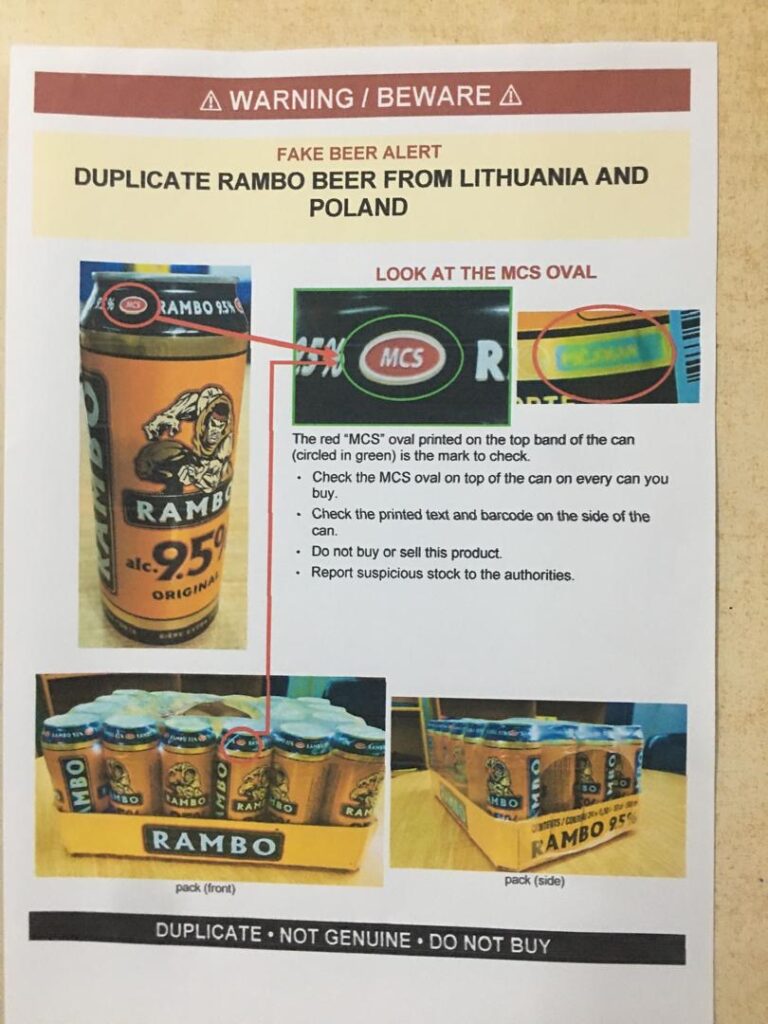
However, serious questions arise when these stated commitments are examined in light of allegations involving M/S Ardagh Group Poland, a subsidiary of the international packaging manufacturer. Agro Value Limited, the legitimate owner of the RAMBO 9.5% Beer trademark, alleges that aluminium cans bearing its protected brand were produced without authorization. If substantiated, these allegations would raise significant concerns regarding intellectual-property protection, commercial integrity, fair competition, and adherence to the ethical business standards that Ardagh Group publicly promotes.
The alleged conduct presents a potential contradiction between Ardagh Group’s stated commitment to trust, excellence, and responsible business practices and the importance of ensuring that all business operations respect the intellectual-property rights of others. It also raises questions about the effectiveness of the Group’s internal controls, compliance procedures, and mechanisms for ensuring that its subsidiaries operate in accordance with its corporate values and ethical commitments.
In light of these allegations, transparency, accountability, and a thorough investigation are essential. Ardagh Group should clarify the circumstances surrounding the alleged unauthorized production, explain the measures taken to protect Agro Value Limited’s intellectual-property rights, and demonstrate how its policies and compliance mechanisms address such concerns. Upholding the principle of “making packaging for good” requires not only environmental sustainability but also respect for the law, ethical commercial conduct, and the rights of legitimate brand owners throughout the value chain.
The case brings into focus the importance of respecting trademark ownership and enforcing intellectual-property laws, particularly where the alleged conduct involves the manufacturing and supply of packaging materials on a commercial scale. The matter underscores the need for transparency, accountability, and appropriate legal remedies to protect the rights of legitimate trademark owners.
The conduct raises fundamental and deeply troubling questions about corporate responsibility, protection of intellectual-property rights, professional ethics, regulatory compliance, internal controls, and the integrity of ARDAGH GROUP’s manufacturing operations.
The production of unauthorized cans bearing a customer’s protected trademark is serious because it compromises the rights and commercial interests of the legitimate trademark owner while exposing the brand, its customers and business partners to substantial financial and reputational harm. Such conduct is wholly inconsistent with the principles of integrity, professionalism and ethical business practice expected of a major international corporation.
ARDAGH GROUP’s conduct has caused substantial commercial and reputational damage to Uganda-based Agro Value Limited, warranting strong condemnation and sanctions.
What makes the matter disturbing is that the legitimate owner of the beer brand had registered its trademark in both the European Union and the United States was also producing the original cans at the same Aluminium plant.
However, due to certain irregularities, duplicate cans were produced at the same plant, side by side with the original cans. This is an extremely serious matter that constitute criminal conduct involving a company listed on the Stock Exchange and one that publicly promotes numerous mission statements, objectives, and ethical commitments concerning integrity and professionalism.
This is not merely a question concerning the manufacture of Aluminium cans. It goes to the heart of corporate governance and internal controls. A company operating on an international scale should have effective procedures to protect customers’ intellectual property, prevent unauthorized production, monitor manufacturing orders and identify irregular transactions.
Through the actions of VYTAUTAS SILEIKIS, the owner of Tautvis, UAB, based in Lithuania, and its sister company, Royal Crown International FZ-LLC, based in a Free Zone registered, to avoid paying corporate taxes, this fraud was orchestrated by offering substantial cash commissions to senior management at the can-manufacturing plant and having them produce thousands of empty cans for shipment to the brewery in Lithuania.
These grave actions should be investigated and tested against documentary, financial, manufacturing and communications evidence so that those responsible are held accountable through the appropriate regulatory processes.
BREWERIES
The cans were then supplied to a subsidiary of OLVI PLC (OLVI OYJ) in Kaunas, AB Volfas Engelman Brewery, where they were filled with 9.5% alcohol beer to replicate the quality and specifications of the original RAMBO 9.5% Beer.
The finished product was subsequently packed in cardboard trays bearing the RAMBO 9.5% Beer markings on the sides. The trays were then shrink-wrapped, after which Maersk was requested to provide a 40-foot container for delivery to the warehouse.
The container was subsequently loaded and transported to Klaipėda Port for shipment to Mombasa Port, Kenya, with the final destination being Goma, eastern Democratic Republic of Congo.
DOCUMENTATION
Fully aware that this was a fraudulent exercise, once the Bill of Lading showing RAMBO Beer 9.5% was generated and the vessel was already en route, instructions were issued from their Dubai office to change the description of the cargo to “malt” or “alcoholic beverage” before the shipment reached Mombasa. Consequently, the description “RAMBO Beer 9.5%” allegedly disappeared from the shipping documentation, making the container difficult to trace through the port of Mombasa.
Once Tautvis UAB discovered that its activities were being investigated by INTERPOL in both Uganda and Poland, Sileikis changed the consignee on the Bill of Lading from the customer’s name in Congo to their entity called Royal Crown International LLC AL –Hamra Industrial Zone –FZ RAS AL Khaimah, UAC General Manager – Vytantas Sileikis.
This was established specifically for fraud transactions but also to avoid thousands of Euros in taxes in Lithuanian by hiding the enormous profits offshore from tax authorities.
However, the Bill of Lading still needed to be amended to ensure that “RAMBO Beer 9.5%” no longer appeared in the cargo description. This exercise of repeatedly changing and concealing the identity and description of the shipment enabled the operation to continue and, ultimately, to expand into larger volumes. These actions clearly shows that they knew it was a fraudulent transaction.
ARDAGH subsequently continued producing the duplicate cans alongside the original cans during this period, as Sileikis was spending a great deal of money.
INCREASE IN VOLUMES
The alleged production of duplicate RAMBO 9.5% cans increased substantially between July 2025 and September 2026, reaching approximately 15 million cans.
This is particularly concerning because ARDAGH’s legal and senior management had already received two cease-and-desist letters – one from legal counsel in Uganda and another from legal counsel in Lithuanian in September/October 2025, yet the production continued.
Despite these formal warnings, the senior management of ARDAGH in Poland, including their legal counsel Caroline Krings and Tomasz Janowski, failed to take immediate action to stop the production and remained silent in the face of the complaints.
Such conduct raise serious questions regarding professional responsibility, corporate ethics, internal controls and management accountability. It was only much later, after legal counsel in London, England, was engaged, that ARDAGH began communicating on the matter through its office in Switzerland.
Original Rambo 9.50%
The CAN was designed by Agro Value Limited, a company registered in Uganda. Following confirmation of the design, the RAMBO 9.5% trademark was registered in Europe, the United States, Uganda, the Democratic Republic of Congo (DRC), South Sudan, and China.
The CANS were manufactured at two facilities. One of the manufacturing plants was ARDAGH in Poland, which produced the cans for more than 10 years, while the beer continues to be manufactured by Obolon Brewery in Ukraine.
Between 2020 and 2023, all orders were suspended as a result of the COVID-19 pandemic. Production and orders resumed in 2023. However, in early 2025, the production of duplicate RAMBO 9.5% cans produced by Ardagh and supplied to AB Volfas Engelman Brewery in Europe began.
RAMBO 9.5% is a highly popular beer, largely because of its high-quality product, distinctive and attractive can design, and durable packaging, which helps minimize damage during transportation, particularly in the DRC market.
Court Cases
Despite the seriousness of the infringement involving ARDAGH, Tautvis, AB Volfas Engelman, and Vytautas Sileikis, the parties have failed to agree to reach a satisfactory resolution to the trademark infringement. Poland Case Number is XX11 GWO 408/26 District Court in Warsaw 22ND Intellectual Property Division.
To begin with, legal proceedings were initiated in Poland in relation to the matter. The case, before Judge IRENEUSZ MATUSIAK, was filed against the relevant parties. However, ARDAGH did not respond to the proceedings, and the matter has subsequently progressed as a formal trademark-infringement case.
The claimant is seeking approximately EUR 1.9 million in general damages from ARDAGH arising from the infringement and its associated commercial consequences. The claimant is represented in Poland by JWP RZECZNICY PATENTOWI DOROTA RZAZEWSKA SP.K., Warsaw, a well-respected intellectual-property law firm.
Proceedings have also commenced in Lithuania, where the matter is being pursued directly as a trademark-infringement claim. The Lithuanian proceedings also involve Tautvis, Royal Crown International, and AB Volfas Engelman, among the other parties concerned.
These proceedings are intended to establish the facts, determine liability, and seek appropriate remedies for the infringement and any resulting losses.
RESPECT
The apparent attitude of ARDAGH and others in this fraud in this matter raises serious concerns. There appears to be a perception that, because Agro Value Limited is a company registered in Uganda and the customers of the duplicate beer are located in the Democratic Republic of Congo (DRC), the standards of ethics, corporate responsibility, professional conduct and respect for intellectual-property rights can somehow be disregarded.
That approach is unacceptable. The fact that the affected business is African, or that the market is in Africa, does not diminish the legal rights of the trademark owner or provide anyone with justification to disregard established ethical and professional standards.
Fortunately, the conduct occurred within Europe, the products were manufactured in Europe, and the companies and individuals involved are subject to European laws and judicial systems. European courts and regulatory authorities provide established mechanisms for addressing alleged intellectual-property violations and corporate misconduct.
It is important to make one principle absolutely clear: being African businesspeople does not mean that our intellectual-property rights, investments, trademarks or businesses are worth less or can be treated with less respect. European companies and individuals must be held to the same standards of law, integrity, accountability and professionalism when dealing with African businesses as they would when dealing with businesses from any other part of the world.
No geographical, racial or commercial distinction should ever be used to justify or excuse fraud, trademark infringement or other unlawful conduct.