By Peter Wamboga-Mugirya (A feature story ) Did you know that the delicious matooke, ndizi, bogoya, gonja and manjaya bananas you enjoy every day, are slowly and surely declining in size of land cultivated and quantities? Uganda’s banana production is shrinking drastically mainly due to soil degradation and land use-change among other major factors, a banana-based cooperative in Western Uganda (in the country’s highest banana production area), has warned. It says the phenomena have led the country drop from the top ten world’s banana producers down to among top 5—a negative trend dating back in early 2000s.

The Uganda Banana Producers’ Cooperative Union Limited, headquartered in Mbarara warns that the staple crop’s output dropped from a high of 10.5 million metric tons per annum in 2002, to a low of 8.5 million metric tons in 2016 [seven years ago].
In a report seen by The Cooperator, the Union reveals that the surface area cultivated with bananas (the dessert and cooking [matooke] types) declined from 1.8 million hectares to less than 1 million hectares. “A recent census found out that 68% of the banana crop was produced in western region followed by central region (23%) the eastern region 8% and northern with less than 1%. More than 75% of farmers grow bananas, the country’s staple food. Depending on the region, Ugandans eat as much as 1kg of bananas per person per day, and this is mainly cooking [matooke] types,” states the Union.

Annual production is currently estimated at 8.45 million tons, accounting for 15% of total world banana/plantain output. In Uganda, over 7 million people including 65% of the urban population depend on the crop grown on 1.3 million hectares, as their staple, two reports corroborate so: USAID’s (pdf.usaid.gov/pdf_docs/PNADJ525.pdf) and Academia’s (www.academia.edu/A_guide_to_successful_banana_production_in_Uganda).
According to the Cooperative Union’s report signed by Asaph Mugizi, the Chairperson Uganda Banana Producers Cooperative Union Ltd, and Sarah Loyce Tusingwire, the General Secretary, there has been a declining trend in banana production, and it is also attributed to poor post-harvest handling, banana bacterial wilt (BBW) and Black sigatoka diseases, and nematode pests. “In addition, there’s limited access to viable management technologies, value-addition technologies and access to better markets and other business opportunities to enable livelihood improvement, job, employment and wealth-creation among the value chain actors….,” the report adds.
One of Uganda’s leading banana research scientists, Dr. Andrew Kiggundu confirms there’s decline in banana yields and productivity affecting national output. He told this author, that soil degradation through erosion and fertility exhaustion via soil-borne nutrient-mining by the heavy-feeder bananas, is the main source of trouble. “Degradation over a long period of time has caused soil infertility especially of the element of potassium. This nutrient is mined by the banana plants from the soil and forms in the bunch [pulp, fruit and in the peels] as the crop grows. This aggregated together, causes accumulated loss of the potassium nutrient critical in banana health and growth. Indeed potassium is declining in the traditional banana-growing regions, affecting banana yields,” Kiggundu explains. He, however, clarifies that there’s expansion of banana countrywide. Most of the output loss, he says, is highly localized not generalized all over Uganda. “Yes: diseases, pests and Climate Change are the other serious challenges causing loss,” he admits, giving credence to what the producer cooperative reports.
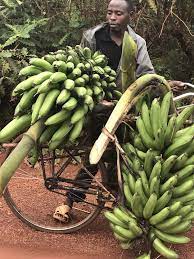
New gardens have emerged in non-traditional banana areas, like the north and Karamoja, Kiggundu adds.
A UK-based Charity, the Gatsby Foundation that sponsors agro-research projects, too confirms there are falling soil fertility trends and attacks from pests and diseases causing yield decrease for decades–a syndrome researchers called ‘banana decline’. But Gatsby says the decline has been gradual. “Over a 15-year period from 1993, Gatsby funded a variety of projects addressing banana decline in Uganda−interventions were made at different points of the research value-chain, with strategies including research into diseases; the multiplication and distribution of improved varieties; farmer training; and the exploration of potential transgenic solutions,” according to a Gatsby report. “In 1993, Gatsby began funding projects to reverse declining banana yields. Early work focused on understanding why new varieties developed with resistance to Black Sigatoka disease were showing symptoms of a virus… Gatsby funded a joint-project between the International Institute for Tropical Agriculture (IITA) and the John Innes Centre in the UK which found varieties were suffering from Banana Streak Disease (BSD), caused by viruses,” says Gatsby. The African Journal on Food, Agriculture, Nutrition and Development (AJFAND) in their report: “Towards Sustainable Highland and Banana Production in Uganda: Opportunities and Challenges” authored by Makerere-based researcher, Kenneth Nyombi among others, reveals that the problem dates back in 1930s. “Yield reductions due to soil fertility decline were reported as early as 1938 in the Lake shore banana growing areas. The existence of “Lunyu soils” that are highly acidic patches and are low in nutrients, was first reported in the 1940s. Banana systems are built on mainly Ferralsols [iron soils] and Acrisols. Although they have good physical conditions, inherent fertility is low and nutrient availability largely depends on mineralization [fertilization] of soil.
The Banana Cooperative Union says the industry provides employment to thousands of people because there is no part of the banana fruit that is not used. “Banana fibers are one of the strongest natural fibers used to make fabrics, handcrafts and many more fashion goods. There has been a declining trend in banana production, and this decline is [also] attributed to poor post-harvest handling, bacterial wilt and sigatoka [diseases] and nematodes. In addition, there’s limited access to viable management technologies, value-addition technologies and access to better markets…,” states in the Union’s report. The public research institution charged with banana research, the Kawanda-based National Agricultural Research Laboratories (NARL) Institute of NARO, is engaged in further expansion of this commercial crop in newer non-traditional areas, to boost further production, provide food security and introduce a new source of incomes. In their report: “Stakeholders’ Consultative Meetings on scaling out banana production and commercialization in Northern Uganda” NARL with support from the United States Agency for International Development (USAID), are implementing a project on scaling out banana production and commercialization in Northern Uganda. The desired vision is to bridge the gap for increased banana production and commercialization. The Head National Banana Research Program at (NBRP) at NARL, Dr. Priver Namanya Bwesigye reveals that communities in banana-growing areas in Uganda are wealthier than those who don’t grow it. “… looking at the map of Uganda on agricultural production of different crops against wealthy areas, people in places where bananas are produced were wealthier than people in areas where it was not produced.” This she says, is because these regions have sufficient food for their families, while in the Northern Uganda it’s not the case because they over-depend on annual crops which are seasonal, yet banana production and yield is year round.
As an arm of NARO, NBRP is mandated to generate banana varieties that improve production and productivity in the country. “Banana is still the most preferred staple crop in Uganda. Its ability to fruit all year round makes it more important for household food security and income… we provide information on how a banana farmer can enhance productivity,” she adds. The Uganda Banana Producers’ Cooperative Union has a comprehensive strategic plan for this crop which tis author has seen. “The Union will focus on the following 3 priority areas: Banana production development, Market Development for Bananas and their Products, The Union’s Growth, Development and Sustainability…. The Union intends to offer banana plantlets, agro-inputs, banana value-chain training manuals, banana juice, animal feeds, banana textiles and household items, biogas from banana peels, banana charcoal briquettes, vinegar from banana peels, agri-tourism, banana consultancy services, affordable access to finance for banana farmers…,” in part according to the Strategic Plan.