

In a Q and A, interview Samuel Hiire Davis the National Coordinator INCE Uganda (Woord en Daad) speaks how they have planned to revamp Uganda’s education sector. Magara Darious the managing editor of eastafricanwatch.net caught up with him and below are the excerpts.
- What is Woord en daad Organisation and what does it do in Uganda?
- Woord en Daad is a Netherlands based Christian organization reaching communities all over the world with a goal of reducing poverty lines. Woord en Daad translate or mean Word and Action. We aim to reach far but remain near (Reach far, Be near). WD was founded 50 years ago and this year they will celebrate our 50 years of life changing impact. It was founded by two Dutch men: one business man and a church pastor. Therefore, our approach to community service is a blend of holistic a mission as witnessed in a mix of business and biblical mindset.
- WD is in more than 28 countries across the globe. In countries like India, Philippine and Guatemala, WD has been working for nearly 50 years.
- WD has 5 focal area which include: Education, Job booster, Water, Agri-business and Sponsorship
- In Africa WD is in many countries among which are: Ethiopia, Senegal, Burkina Faso, Benin, Chad and now Uganda.
- What have you planned for the teachers especially the needy ones in order to help them become graduates?
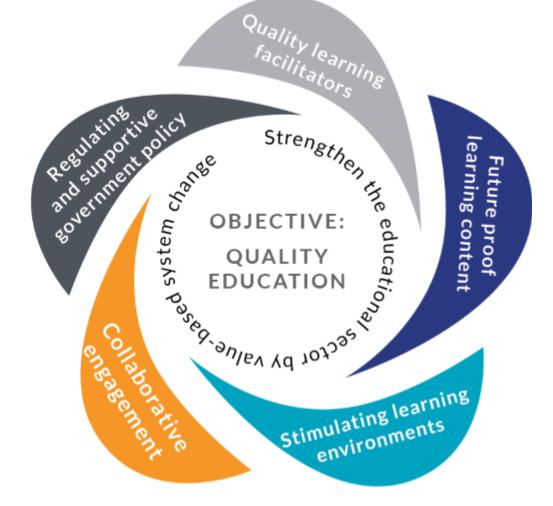
- WD’s vision for Uganda’s education is “Structurally improving educational quality through a value-based systemic change approach”. We believe that going to school is good but it is not enough without realizing high quality education.
- Our definition of quality education hinges along 5 pillars, namely: 1. Quality learning facilitators (teachers), 2. Future proof learning content (curriculum), 3. Stimulating learning environment, 4. Collaborative engagement in learning, and 5. Supportive government policies
- Educational quality can be summarized further in three arms as illustrated below;
To achieve our goal for quality education in Uganda, we plan to work collaboratively with the different stakeholders with the MoES being our biggest and prioritized partner. Through UNITE, LivingStone International University and other consortium members we are working toward develop a teacher education curriculum at bachelors level that is future proof with values, life skills and C21st skills integrated as a way of preparing our graduates for the Uganda we want.
In the first phase of this project we are targeting to sponsor with scholarships a total of 1200 teachers for both primary and secondary schools who are not graduates will be given scholarships to study and become graduate teachers. This program which has already started will effectively start in January 2024.
The education we are talking about is value-based education and we are working in consortium with other organizations and partnering with the government of Uganda to realise this vision and dream. It is a big and hard dream but we are ready to work towards that because we need it. Education is what makes a nation, what have you taught or trained the tutors and teachers eventually has a bearing on what
Our learners the pupils are taught as much as we know the home is also another learning area(institution).
When we say we want the teachers to be trained with a value-based approach it’s a wide thing in a sense that we have to have the right curriculum for especially the Primary and secondary school education levels.
-
- What are you doing about these curriculums for Primary and secondary school education levels?
- In line with realigning and gearing toward high quality value-based and practice led teachers for Uganda, we are training university lecturers from the different universities in the way we wish them to teach. In partnership with Driestar Christian University from Gouda – Netherlands, we have started this journey. In early June we worked with over 40 lecturers in shaping a value-based practice-oriented teacher training curriculum framework.
- Uganda National Institute for Teacher Education (UNITE) a specialized university for education in Uganda is one of our strategic partners. With and through UNITE we believe we shall shape a curriculum that will change the game of teacher training in the country.
- In the first phase of rolling out 1200 teachers’ scholarships how much money have you planned to inject in this and who is the sponsor?
- With the five satellite compasses of UNITE we also wish to support the underprivileged teachers who might otherwise not afford to upgrade to a bachelor’s degree access this high-quality value-based practice led curriculum. The initial pilot will see us offer scholarships to over 1,200 teachers from six select districts of Zombo, Otuke, Bukadea, Kasanda, Ntungamo and Jinja. The bigger picture is to support close 100,000 teacher by 2030.
- This ambition is in effort to supplement the government goals of having the minimum qualification for teachers at a bachelor’s level by 2030. We want to support the government. We want our youth and children to experience real education. We wish to see our graduates gain a holistic formation.
- There is a complaint that teachers salaries is very low or small in Uganda and therefore so discouraging and their general work environment, what do have to say about this?
- It is true the teacher’s salary in Uganda is very small but how much is enough salary? I think and believe that teachers especially those that will interface with our training (planned bachelors in education) will first of all learn that teaching is a profession and a vacation. They will be required to love what they do and also how they can take advantage of the time they have outside school time to be productive.
- Once teachers are helped to appreciate that teaching is a calling and they are in education to change and contribute to a better future, then they will willingly navigate the hurdles. Teacher affect eternity, and they won’t know how far their influence goes. Thus, through accessing high quality teacher education, every teacher, I believe will be creative and innovative to make ends meet. Remember, through our other pillar or intervention on supportive government policies, we believe our government is heading in the right direction and very soon teachers will wear beautiful smiles.
6 .Do teachers need financial literacy?
- Teachers do not only need to be good at their subject of authority but also understanding the dynamics of life. Financial literacy and self-leadership are some of the attributes of a complete teacher. This curriculum we are talking about and our complete intervention will give us complete graduate teacher for a complete education output. Therefore, we are convinced that through a collaborative engagement and supportive government policies our new breed of teachers will not only teacher for exams but also for eternity
- At the moment many teachers are being cheated becoming prey to ill-intentioned money lenders. Ann many have abandoned the profession as a result of being taken advantage of. Any kind of enlightenment in financial literacy can save the situation.
- Do you have some best practices of the education sector in Africa and what do they do which we can learn from them?
- Ghana and Kenya are have developed good competence-based education systems and it proving a good foundation for their education system. Good education impact on the character of the children we produce and the competences and skills they develop which become problem, challenge solvers in companies, communities and organizations and in homes. If today you have reckless drivers who are killing our people on the roads, corrupt government officials it tells you the type of education or training they have acquired from wherever they have learnt from.
And our people have to be taught that corruption even when committed by one person affects all of us including those who have committed it.
8. What are the 4 Hs in education and how do they relate to the education sector? (Heart knowledge values, Heart convictions, Education for the hands, education for the home).
- H1 – Head education or education for the head – this refers to the intellectual development of the learners. This is the academic part of the development of humanity. Today our education is only focusing on this tenet of development. Logical reasoning is great but without character or value it vulnerable to being corrupted.
- H2 – Heart education or education for the heart – this is to do with character formation. One guy said, “Education of the mind at the expense of the heart will only create clever devil.” Our education should be value-based. It should engage the heart where character is shaped and where values are stored. I want to say that that state of corruption in our country is not because we luck intellectual, but it is because we luck values and character. There is a devoid of the right heart convictions.
- H3 – Education for the hands (skills or practice) – after developing the intellect and morals, we also need graduates who are skilled and productive. A practice-oriented education is the answer to Uganda’s unemployment. Skills like problem-solving, innovation, collaboration, creativity, strategic thinking and reasoning are key in developing countries like Uganda.
- H4 – Education for the house – this is do with community engagement and this is where collaborative engagement comes in. All idlers, corrupt individuals and heartless persons come from a place called home or community. Unless our communities are challenged to divorce from the blame game and own our moral decay state, we are very far from transforming our country. Every single Ugandan is a contributor to the state of affairs at hand. We shall experience a new Uganda when all Ugandans realise that.
9 And you have 5 pathways to education, what are they and how do they relate to the education sector? Briefly
- Curriculum Improvement: Value-based, practice oriented high quality teacher education curriculum. By this we believe that curriculum should be future proof. Our strategic partners are UNITE, Livingstone International University, Driestar Christian University and Bereans Education Initiative
- Teacher educator training (Quality Learning Facilitators that are value-based and practice oriented) our strategic partners are Ministers of Education, UNITE, EDIFY, LIU, DCU, Bereans, etc
- School improvement and parent/community involvement (Collaborative engagement) our strategic partners are: District Local government, EDIFY Uganda, Global Leadership Summit, TRURI consults
- Teacher scholarships and Consortium (Access to high quality BE programme) our strategic partners are: UNITE, LIU, EDIFY, DLGs, TRURI, etc.
Policy influence (supportive government policies) Our strategic partners: UNITE, LIU, EDIFY, DLGs, GLS, etc.
-
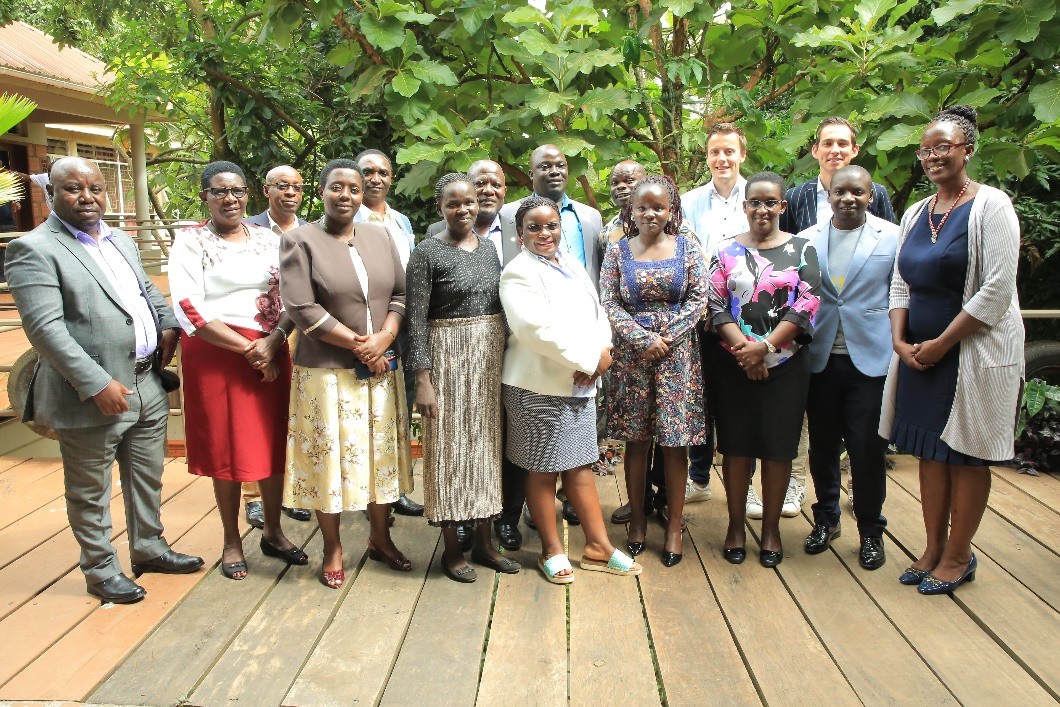
Consortium members pic.(above). 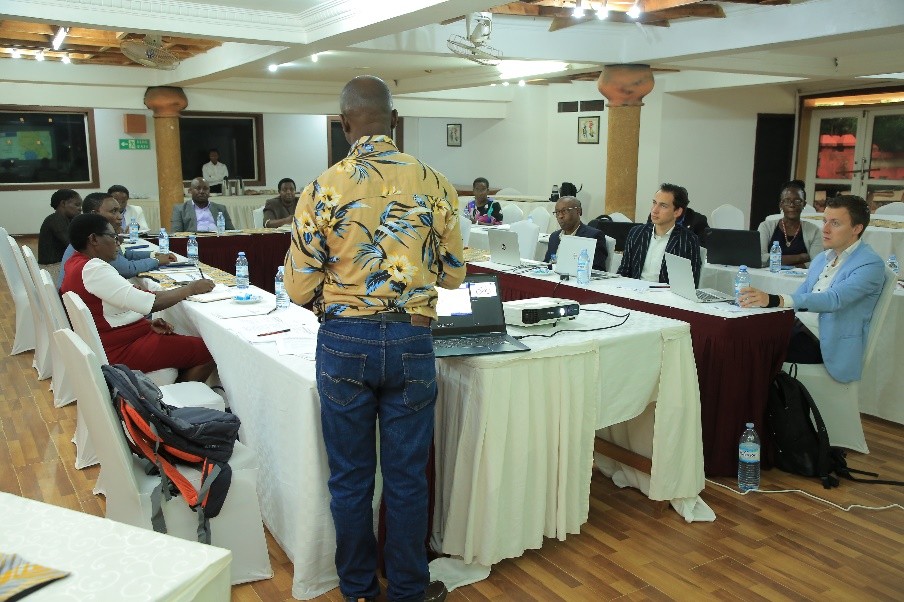
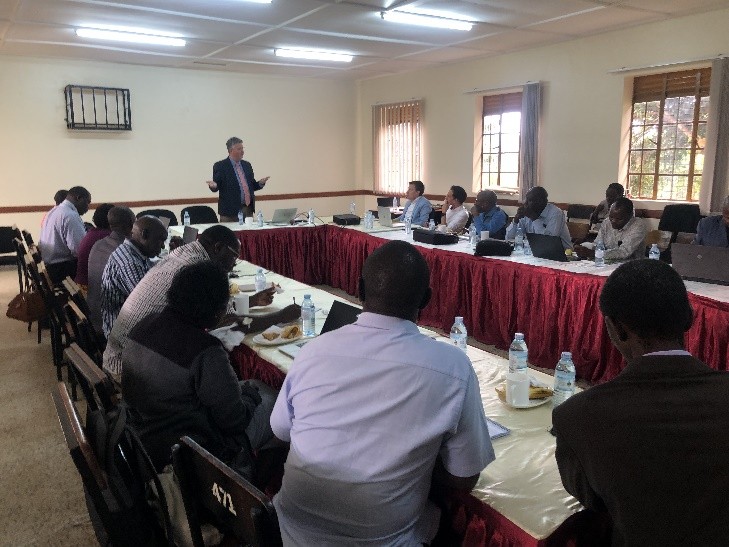
Stakeholders during the formation of the consortium
10. What is Woord en daad Organisation’s future plan for the education sector in Uganda?
– WD has a long-term plan for Uganda’s education. We wish to see our education sector revamped and improved. We wish to support the government in enabling underprivileged teachers to access university education of high quality. Collaboration through a consortium is our driving force and motivation.
The target of those that will be helped with scholarships to acquire bachelors degrees in education is big but we will be rolling out phase by phase.


